

AI Jobs for Freshers India 2026 - 3.8 Lakh Vacancies Complete Guide
India mein AI jobs 2026 mein 3.8 lakh vacancies hain. Freshers ke liye complete guide - skills, salary, top companies aur career tips.
 Rate the Images
AI Jobs for Freshers India 2026 - 3.8 Lakh Vacancies Complete Guide
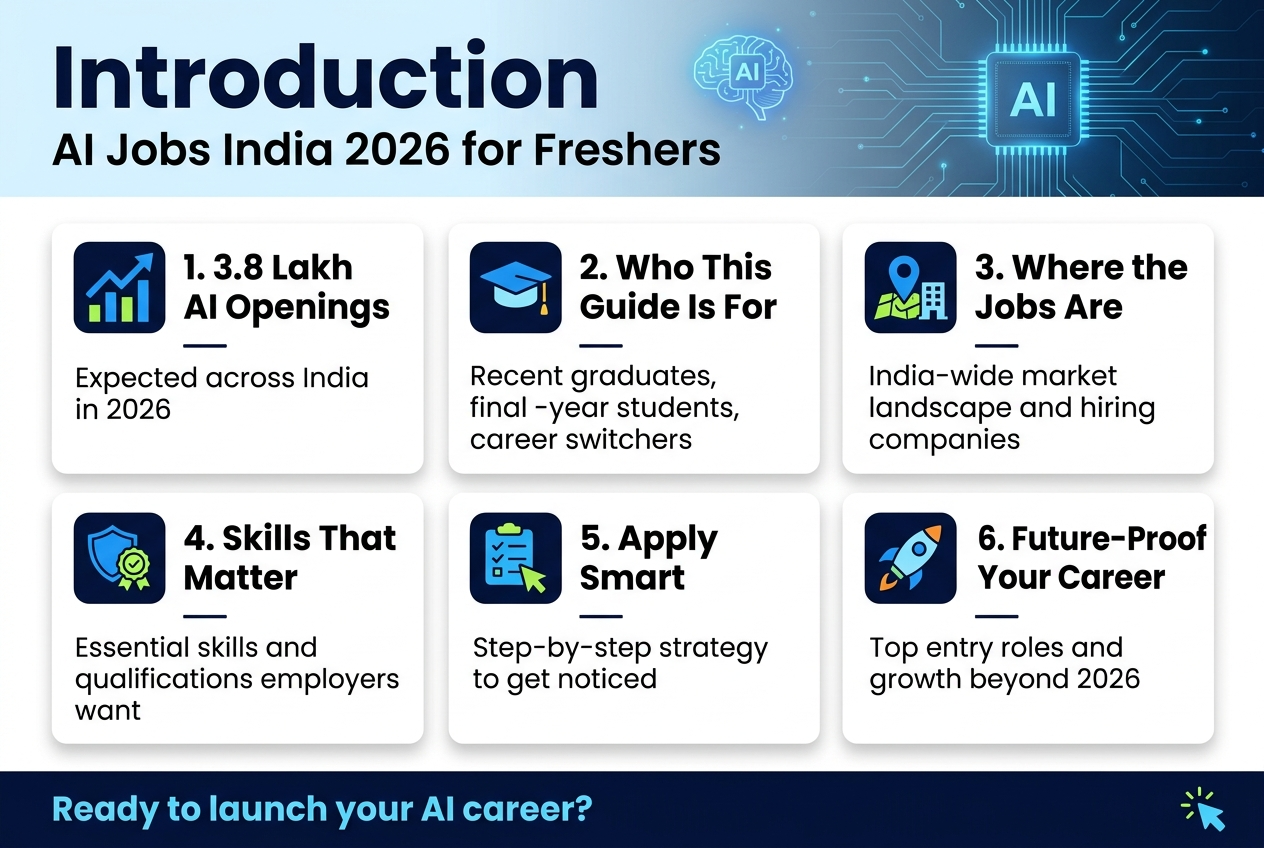
India's AI sector is exploding with opportunities, and 2026 looks like the perfect time for fresh graduates to jump in. With over 3.8 lakh AI job openings expected across the country, this complete guide breaks down everything new graduates need to know about landing their first AI role.
This guide is designed for recent graduates, final-year students, and career switchers who want to break into artificial intelligence without years of experience holding them back.
We'll walk you through the current AI job market landscape in India, showing you exactly where the opportunities are and which companies are actively hiring freshers. You'll also discover the essential skills and qualifications that actually matter to employers, plus a step-by-step application strategy that maximizes your chances of getting noticed. Finally, we'll explore the top AI job roles that are perfect for fresh graduates and how to future-proof your career beyond 2026.
Ready to turn AI jobs India 2026 freshers opportunities into your career launchpad? Let's dive in.
Current AI Job Market Landscape in India
Industry Growth Statistics and Projections for 2026
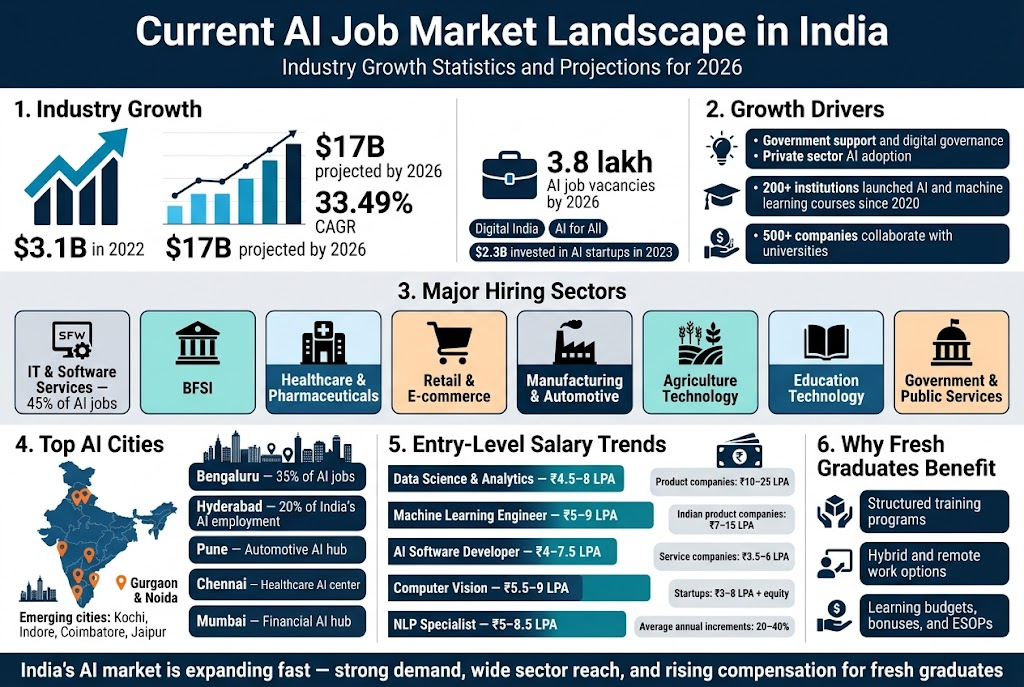
India's AI industry stands at a remarkable inflection point. The sector has experienced explosive growth, with market size expanding from $3.1 billion in 2022 to a projected $17 billion by 2026. This represents a compound annual growth rate (CAGR) of 33.49%, making India one of the fastest-growing AI markets globally.
The statistics paint an encouraging picture for fresh graduates entering the field. Current data reveals approximately 3.8 lakh AI-related job vacancies expected to emerge across various sectors by 2026. This massive demand surge stems from India's digital transformation initiatives, government support through policies like the National AI Portal, and private sector investments exceeding $2.3 billion in AI startups during 2023 alone.
Market Expansion Drivers
Several factors contribute to this unprecedented growth trajectory. The Indian government's push for digital governance through initiatives like Digital India and AI for All has created substantial public sector demand. Meanwhile, private enterprises are rapidly adopting AI solutions to remain competitive in global markets.
The talent pool expansion significantly influences market dynamics. Indian universities now offer specialized AI and machine learning programs, with over 200 institutions launching dedicated courses since 2020. Engineering colleges report 40% increased enrollment in AI-related specializations, creating a robust pipeline of qualified candidates.
Investment Flow Patterns
Venture capital and private equity investments in Indian AI startups reached record highs. Funding rounds exceeding $100 million became commonplace, with companies like Fractal Analytics, Haptik, and Mad Street Den securing substantial investments. This capital influx directly translates to job creation, particularly for entry-level positions.
Foreign direct investment (FDI) in AI-related sectors topped $4.2 billion in 2023, with multinational corporations establishing dedicated AI research centers in India. Companies like Google, Microsoft, Amazon, and IBM have expanded their Indian operations specifically to tap into local AI talent.
Skill Development Infrastructure
The government's skill development initiatives have created pathways for AI jobs India 2026 freshers to enter the workforce. Programs like the Skill India Digital initiative offer AI training modules, while the Ministry of Electronics and Information Technology (MeitY) has launched specialized certification programs.
Corporate partnerships with educational institutions have multiplied. Over 500 companies now collaborate with universities on AI curriculum development, internship programs, and placement guarantees. These partnerships ensure graduates possess industry-relevant skills from day one.
Market Maturity Indicators
The Indian AI market shows signs of healthy maturity. Rather than focusing solely on research and development, companies now emphasize practical AI implementation across business functions. This shift creates diverse opportunities for freshers beyond traditional tech roles.
Professional services firms report 60% increased demand for AI consulting services. This trend opens doors for fresh graduates who can bridge the gap between technical AI capabilities and business requirements.
Global Competitiveness Position
India ranks third globally in AI research publications and fourth in AI patent applications. This research foundation translates into commercial opportunities as academic innovations find market applications. The country's cost advantage in AI development services has attracted international clients, creating additional job opportunities.
The "AI-as-a-Service" market in India is projected to reach $2.8 billion by 2026, representing significant growth from the current $400 million. This expansion creates opportunities across the value chain, from algorithm development to customer support roles.
Major Sectors Driving AI Employment Demand
The AI employment landscape in India spans multiple sectors, each presenting unique opportunities for fresh graduates. Understanding these sectors helps candidates align their skills with market demands and identify the most promising career paths.
Information Technology and Software Services
The IT sector remains the largest employer of AI professionals, accounting for approximately 45% of all AI jobs in India. Major players like Infosys, TCS, Wipro, and HCL have established dedicated AI divisions, creating thousands of entry-level positions annually.
These companies focus on AI-driven solutions for international clients, particularly in automation, data analytics, and customer service enhancement. Fresh graduates find opportunities in roles such as AI trainers, data annotators, algorithm testers, and junior machine learning engineers.
The sector's advantage lies in its structured training programs. Most IT companies offer comprehensive 6-12 month training programs for fresh hires, covering both technical skills and client interaction capabilities. Success rates for freshers entering through these programs exceed 85%.
Banking, Financial Services, and Insurance (BFSI)
The BFSI sector has emerged as a significant AI employer, driven by digital transformation initiatives and regulatory compliance requirements. Banks like ICICI, HDFC, and Axis Bank have deployed AI for fraud detection, risk assessment, and customer service automation.
Insurance companies utilize AI for claims processing, policy recommendation, and underwriting automation. This creates demand for professionals who understand both AI technology and financial domain knowledge.
Entry-level positions include risk analysts, customer data scientists, compliance automation specialists, and digital banking consultants. The sector offers competitive compensation packages, often 20-30% higher than traditional IT roles.
Healthcare and Pharmaceuticals
Healthcare AI adoption has accelerated significantly, creating new job categories for fresh graduates. Hospitals implement AI for diagnostic imaging, patient management, and treatment optimization. Pharmaceutical companies use AI for drug discovery, clinical trials, and regulatory compliance.
Opportunities exist for medical data analysts, healthcare software developers, clinical AI specialists, and regulatory affairs coordinators. The sector particularly values candidates with interdisciplinary knowledge combining AI skills with healthcare understanding.
Government initiatives like the Ayushman Bharat Digital Mission have created additional demand for healthcare AI professionals. Public health projects require specialists who can develop AI solutions for rural healthcare delivery and telemedicine platforms.
Retail and E-commerce
E-commerce giants like Flipkart, Amazon India, and Myntra extensively use AI for recommendation engines, supply chain optimization, and customer service automation. The sector creates diverse opportunities from technical development to business analysis roles.
Traditional retail chains are also embracing AI for inventory management, pricing optimization, and customer behavior analysis. This expansion creates opportunities in companies that previously had limited technology requirements.
Fresh graduates find roles in product recommendation systems, customer analytics, supply chain optimization, and digital marketing automation. The sector's fast-paced environment provides excellent learning opportunities and rapid career progression.
Manufacturing and Automotive
Industry 4.0 adoption in manufacturing has created substantial AI employment opportunities. Companies like Bajaj Auto, Mahindra, and Tata Motors use AI for predictive maintenance, quality control, and production optimization.
The automotive sector's shift toward electric vehicles and autonomous driving technology creates specialized AI roles. Fresh graduates work on projects involving computer vision, sensor data analysis, and autonomous navigation systems.
Manufacturing AI roles include production optimization analysts, quality assurance specialists, supply chain coordinators, and IoT system administrators. The sector offers stable employment with opportunities for hands-on technical experience.
Agriculture Technology
Agricultural AI represents an emerging high-growth sector. Companies develop AI solutions for crop monitoring, weather prediction, soil analysis, and market price forecasting. Government initiatives supporting digital agriculture have amplified demand in this sector.
Startups focusing on agricultural AI have raised significant funding, creating job opportunities in rural technology implementation. Fresh graduates work on projects involving satellite imagery analysis, sensor networks, and farmer advisory systems.
Roles include agricultural data scientists, rural technology coordinators, crop optimization specialists, and farmer interface developers. The sector offers opportunities to work on socially impactful projects while gaining valuable AI experience.
Education Technology
The education sector's digital transformation has accelerated AI adoption. EdTech companies use AI for personalized learning, student assessment, and content recommendation. The COVID-19 pandemic further accelerated this trend.
Companies like BYJU's, Unacademy, and Vedantu employ AI specialists for platform development, student performance analysis, and content optimization. Traditional educational institutions also invest in AI for administrative efficiency and learning enhancement.
Entry-level opportunities include learning analytics specialists, content personalization experts, student success coordinators, and educational platform developers. The sector combines technology skills with educational impact.
Government and Public Services
Government AI adoption has created new employment categories in public sector organizations. Projects include citizen service automation, traffic management, crime prediction, and administrative efficiency enhancement.
State governments launch AI initiatives for governance improvement, creating opportunities for fresh graduates interested in public service. Smart city projects across Indian cities require AI specialists for implementation and maintenance.
Government AI roles include public service automation specialists, civic technology coordinators, policy implementation analysts, and smart city project managers. These positions offer job security and opportunities to work on large-scale societal impact projects.
Geographic Distribution of AI Opportunities Across Indian Cities
The distribution of AI employment opportunities across Indian cities reflects the country's technology infrastructure, educational ecosystem, and business environment. Understanding this geographic landscape helps fresh graduates make informed decisions about career locations and growth prospects.
Bengaluru - The AI Capital
Bengaluru dominates India's AI employment landscape, hosting approximately 35% of all AI jobs in the country. The city's ecosystem includes over 2,000 AI-focused companies, from global giants to innovative startups. Major employers include Google Research India, Microsoft Research, Amazon Development Centre, and indigenous companies like Flipkart and Infosys.
The city's advantages extend beyond company presence. Bengaluru houses premier educational institutions like the Indian Institute of Science (IISc), which conducts cutting-edge AI research. The Robert Bosch Centre for Data Science and Artificial Intelligence at IISc serves as a bridge between academic research and industry applications.
Fresh graduates benefit from Bengaluru's vibrant meetup culture and professional networks. The city hosts over 50 AI-related events monthly, providing networking opportunities and skill development platforms. Co-working spaces specifically cater to AI startups, fostering collaboration and knowledge sharing.
Salary ranges in Bengaluru typically exceed national averages by 15-20%. Entry-level AI positions offer packages between ₹6-12 lakhs annually, with rapid progression opportunities. The city's high cost of living is offset by superior growth prospects and learning opportunities.
Hyderabad - The Rising Star
Hyderabad has emerged as a significant AI hub, particularly strong in government-backed initiatives and large-scale enterprise implementations. The city hosts major technology centers for companies like Microsoft, Google, Amazon, and Facebook, contributing to approximately 20% of India's AI employment.
The Telangana government's proactive technology policies have attracted AI investments. The T-Hub incubator specifically supports AI startups, while the Telangana AI Mission creates public-private partnerships for AI implementation. These initiatives generate diverse opportunities for fresh graduates.
HITEC City serves as the epicenter of Hyderabad's AI activities. The area concentrates major technology companies, research institutions, and startup incubators. Transportation infrastructure and urban planning support the technology workforce effectively.
Educational institutions like the International Institute of Information Technology Hyderabad (IIIT-H) and the University of Hyderabad contribute to local talent development. Industry-academia collaborations create internship opportunities and placement guarantees for students.
Pune - The Automotive AI Hub
Pune's traditional strength in automotive manufacturing has evolved into automotive AI leadership. The city hosts AI research centers for major automotive companies, including Bajaj Auto, Mahindra & Mahindra, and Tata Motors. This specialization creates unique opportunities for AI jobs India 2026 freshers interested in automotive technology.
The Pune Software Exporters Association (SEAP) actively promotes AI adoption across member companies. Regular skill development programs and certification courses help fresh graduates acquire industry-relevant capabilities.
Educational institutions like the College of Engineering Pune (COEP) and Pune Institute of Computer Technology (PICT) maintain strong industry connections. Placement records show 90%+ success rates for AI-specialized graduates.
Living costs in Pune remain moderate compared to other major tech cities, making it attractive for fresh graduates. The city's cultural diversity and recreational opportunities enhance work-life balance.
Chennai - The Healthcare AI Center
Chennai has developed particular strength in healthcare AI applications, leveraging the city's medical infrastructure and pharmaceutical industry presence. Companies like Apollo Hospitals, Dr. Reddy's Laboratories, and various biotech firms employ AI specialists for medical research and healthcare delivery optimization.
The Indian Institute of Technology Madras (IIT Madras) houses the Robert Bosch Centre for Data Science and Artificial Intelligence, conducting world-class research in healthcare AI. Academic-industry partnerships create direct pathways for fresh graduates into specialized roles.
Chennai's automotive industry, including companies like Ford, Hyundai, and Renault-Nissan, increasingly incorporates AI for manufacturing optimization and autonomous vehicle development. This creates crossover opportunities between healthcare and automotive AI applications.
The city's relatively lower cost of living compared to Bengaluru and Mumbai makes it attractive for fresh graduates. Government initiatives supporting technology adoption in Tamil Nadu create additional public sector opportunities.
Mumbai - The Financial AI Hub
Mumbai's position as India's financial capital translates into leadership in financial services AI applications. Major banks, insurance companies, and fintech startups headquartered in Mumbai drive substantial AI employment demand.
The city hosts research centers for global financial services companies, including Goldman Sachs, JP Morgan, and Deutsche Bank. These organizations focus on algorithmic trading, risk management, and regulatory compliance applications of AI.
Mumbai's startup ecosystem includes numerous fintech companies developing AI-powered financial products. Companies like Payme India, Lendingkart, and PolicyBazaar create entry-level opportunities for AI specialists with financial domain interest.
Educational institutions like the Indian Institute of Technology Bombay (IIT Bombay) and Tata Institute of Fundamental Research (TIFR) contribute to Mumbai's AI talent pool. Industry collaborations provide internship and placement opportunities.
Gurgaon and Noida - The NCR Advantage
The National Capital Region, encompassing Gurgaon and Noida, benefits from proximity to government decision-making centers and major corporate headquarters. This creates unique opportunities in government AI projects and enterprise AI implementations.
Gurgaon hosts numerous multinational corporations' Indian headquarters, including many companies investing heavily in AI capabilities. The city's business-friendly environment attracts AI startups and established companies alike.
Noida's lower operational costs compared to Gurgaon make it attractive for AI companies seeking cost optimization. The city houses major software development centers and emerging AI startups.
Government AI initiatives emanating from Delhi create opportunities for fresh graduates interested in public sector AI applications. Smart city projects across NCR require AI specialists for implementation and maintenance.
Emerging AI Cities
Several Tier-2 cities are developing AI capabilities, creating opportunities for fresh graduates seeking alternatives to major metropolitan areas. Kochi has emerged as an AI center in Kerala, supported by government initiatives and educational institutions.
Indore, Coimbatore, and Jaipur are developing AI capabilities in their respective regions. These cities offer lower living costs and less competition while providing growth opportunities in emerging markets.
The geographic distribution of AI opportunities continues evolving as companies seek talent cost optimization and government initiatives promote technology adoption across regions. Fresh graduates can leverage this expansion to find opportunities aligned with their location preferences and career goals.
Salary Trends and Compensation Packages for Entry-Level Positions
Understanding compensation trends empowers fresh graduates to negotiate effectively and make informed career decisions. The AI job market in India offers competitive packages that often exceed traditional IT roles, reflecting the specialized skills required and high demand for talent.
Entry-Level Salary Ranges by Role Category
Data Science and Analytics roles typically offer starting packages between ₹4.5-8 lakhs annually for fresh graduates from tier-1 institutions, while graduates from tier-2 institutions can expect ₹3.5-6 lakhs. Machine Learning Engineer positions command slightly higher compensation, ranging from ₹5-9 lakhs for beginners.
AI Software Developer roles offer competitive packages between ₹4-7.5 lakhs annually, with additional compensation often tied to project completion bonuses and skill certifications. Research Assistant positions in AI typically range from ₹3.5-6 lakhs, though academic institutions may offer lower cash compensation offset by learning opportunities and publication credits.
Computer Vision specialists, despite being fresh graduates, command premium packages due to skill scarcity. Entry-level positions range from ₹5.5-9 lakhs annually, with opportunities for rapid salary progression based on project success.
Natural Language Processing specialists enjoy similar premium positioning, with fresh graduate packages ranging from ₹5-8.5 lakhs. The growing demand for conversational AI and language processing applications drives this premium.
Company Category-Based Compensation Patterns
Product companies typically offer the highest compensation packages for AI roles. Global technology companies like Google, Microsoft, Amazon, and Facebook offer fresh graduate packages ranging from ₹10-25 lakhs annually, including stock options and performance bonuses.
Indian product companies such as Flipkart, Swiggy, Zomato, and Paytm offer competitive packages between ₹7-15 lakhs for fresh graduates. These companies often provide faster career progression and greater responsibility compared to traditional service companies.
Service companies, including TCS, Infosys, Wipro, and HCL, offer structured entry-level programs with packages ranging from ₹3.5-6 lakhs annually. While initial compensation may be lower, these companies provide comprehensive training and global exposure opportunities.
Startups present variable compensation structures, often combining lower base salaries (₹3-8 lakhs) with equity participation. Successful startup equity can provide significant long-term returns, though this involves higher risk compared to established companies.
Geographic Salary Variations
Bengaluru leads in AI compensation levels, with fresh graduate packages averaging 15-20% above national levels. The city's competitive talent market and concentration of high-paying companies drive this premium.
Mumbai and Hyderabad follow closely, with packages typically 10-15% above national averages. These cities' strong industry presence and lower talent supply relative to demand support higher compensation levels.
Pune offers competitive packages while maintaining moderate living costs, making it attractive for fresh graduates seeking optimal take-home compensation. Packages typically align with national averages while providing better lifestyle value.
Chennai and NCR cities (Gurgaon/Noida) offer packages slightly below Bengaluru levels but often provide better work-life balance and growth opportunities. Government projects in NCR sometimes offer additional benefits beyond base compensation.
Tier-2 cities present emerging opportunities with packages 10-20% below major metro areas but significantly lower living costs. Cities like Kochi, Coimbatore, and Indore are developing AI capabilities while offering attractive total compensation packages.
Component-Wise Compensation Analysis
Base salary typically constitutes 70-80% of total compensation for fresh graduates in AI roles. This provides stable income while other components add variable earning potential.
Performance bonuses range from 10-25% of base salary, depending on individual and company performance. AI roles often tie bonuses to specific project outcomes, creating incentives for skill development and result delivery.
Stock options or Employee Stock Ownership Plans (ESOPs) are increasingly common, particularly in product companies and startups. While these provide no immediate cash benefit, successful companies can generate significant long-term wealth.
Signing bonuses for premium AI roles can range from ₹50,000-3 lakhs, particularly for candidates with specialized skills or competing offers. These bonuses often include retention clauses requiring specific tenure commitments.
Learning and development budgets, ranging from ₹25,000-1 lakh annually, support continuous skill enhancement. Companies recognize the rapid evolution of AI technology and invest in employee skill updates.
Benefits and Perquisites Packages
Healthcare benefits typically include comprehensive medical insurance for employees and family members. Premium companies often provide coverage up to ₹5-10 lakhs annually with minimal employee contributions.
Flexible working arrangements have become standard, with most companies offering hybrid or fully remote options. This flexibility particularly benefits fresh graduates seeking work-life balance optimization.
Professional development opportunities include conference attendance, certification reimbursements, and advanced course enrollments. Companies often allocate ₹50,000-2 lakhs annually for employee skill development.
Relocation assistance for candidates moving to new cities typically covers transportation, temporary accommodation, and setup costs. This support facilitates talent mobility across geographic markets.
Food and transportation allowances, ranging from ₹5,000-15,000 monthly, help offset daily working expenses. Some companies provide subsidized meals or transportation services.
Salary Progression Trajectories
Fresh graduates in AI roles typically experience rapid salary progression due to skill scarcity and high demand. Average annual increments range from 20-40% for the first three years, compared to 10-15% in traditional IT roles.
Skill-based progression often outpaces tenure-based advancement. Professionals demonstrating expertise in emerging areas like computer vision, robotics, or advanced analytics can achieve 50-100% salary increases through role changes.
Leadership pathway progression allows technical specialists to transition into management roles with corresponding compensation increases. Team lead positions typically command 40-60% premiums over individual contributor roles.
Specialization premiums reward deep expertise in specific AI domains. Professionals developing recognized expertise in areas like autonomous vehicles, medical AI, or financial algorithms can command significant compensation premiums.
Industry-Specific Compensation Patterns
Financial services companies typically offer the highest compensation packages, reflecting regulatory requirements and revenue generation potential of AI applications. Fresh graduate packages often exceed other sectors by 20-30%.
Healthcare AI roles offer competitive compensation with high growth potential as the sector expands. Pharmaceutical companies particularly value AI specialists for drug discovery and clinical trial optimization.
Automotive AI positions provide stable compensation with increasing premiums as autonomous vehicle development accelerates. Companies invest heavily in AI talent for competitive advantage.
E-commerce and retail AI roles offer competitive packages with performance-linked incentives tied to business impact metrics. Success in improving customer experience or operational efficiency can generate substantial bonus payments.
Government and public sector AI roles typically offer lower cash compensation but provide job security, pension benefits, and opportunities for societal impact. These positions appeal to candidates prioritizing stability and public service.
The compensation landscape for AI jobs India 2026 freshers continues evolving rapidly as demand outpaces supply. Fresh graduates armed with relevant skills and market knowledge can negotiate competitive packages while building foundation skills for long-term career success. Understanding these trends enables informed decision-making about role selection, geographic preferences, and career trajectory planning.
Essential Skills and Qualifications for AI Freshers
Technical Programming Languages You Must Master
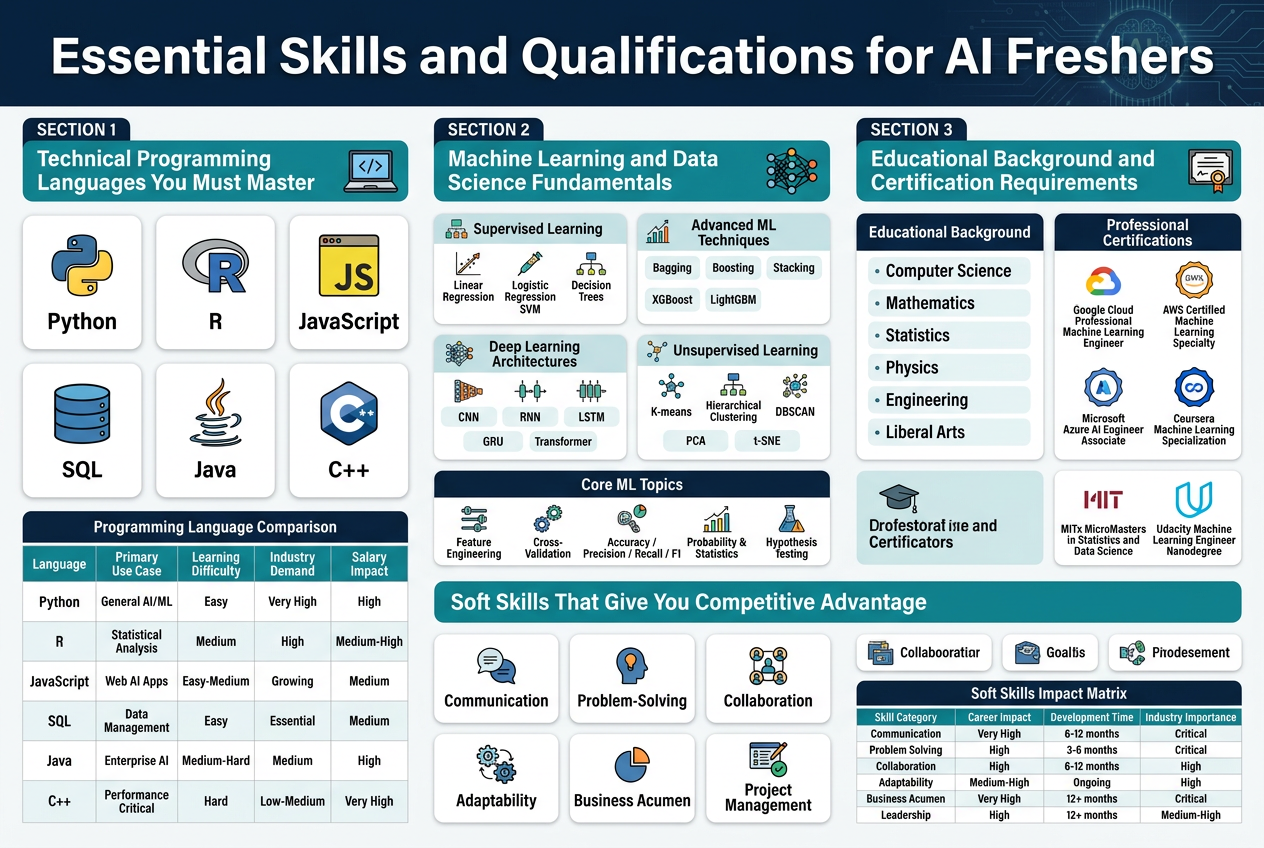
Python stands as the undisputed champion for AI jobs India 2026 freshers, and there's a good reason for this dominance. This versatile language offers an incredibly gentle learning curve while packing serious computational power. When you're diving into machine learning algorithms, data manipulation, or neural network development, Python's extensive library ecosystem becomes your best friend.
The core Python libraries you need to master include NumPy for numerical computing, Pandas for data manipulation and analysis, Matplotlib and Seaborn for data visualization, and Scikit-learn for machine learning implementations. These aren't just nice-to-have skills – they're absolutely essential for landing those coveted AI positions.
Advanced Python Frameworks for AI Development
TensorFlow and PyTorch represent the heavyweight champions of deep learning frameworks. TensorFlow, Google's brainchild, excels in production environments and offers TensorFlow Lite for mobile deployments. The framework's computational graph approach and robust ecosystem make it perfect for large-scale AI applications.
PyTorch, Facebook's contribution to the AI world, wins hearts with its dynamic computational graphs and intuitive debugging capabilities. Many research teams prefer PyTorch because it feels more like writing regular Python code, making experimentation and prototyping significantly smoother.
Keras deserves special mention as a high-level neural networks API that can run on top of TensorFlow. Its user-friendly interface allows rapid prototyping, making it perfect for beginners who want to build neural networks without getting bogged down in low-level implementation details.
R Programming for Statistical Analysis
While Python dominates general AI development, R maintains a strong position in statistical analysis and data science roles. Companies working with complex statistical models, biostatistics, or financial modeling often prefer R for its specialized statistical packages and visualization capabilities.
R's strength lies in packages like ggplot2 for advanced data visualization, caret for machine learning workflows, and dplyr for data manipulation. If you're targeting roles in pharmaceutical companies, financial institutions, or research organizations, R proficiency can set you apart from other candidates.
JavaScript for AI Web Applications
The rise of AI-powered web applications has made JavaScript increasingly valuable for AI freshers. TensorFlow.js allows you to run machine learning models directly in browsers, while Node.js enables server-side AI applications.
Popular JavaScript libraries for AI include ml5.js for creative coding and machine learning in the browser, Brain.js for neural networks, and D3.js for sophisticated data visualizations. Understanding JavaScript opens doors to full-stack AI development roles where you'll build user-facing AI applications.
SQL and Database Management
Data forms the backbone of every AI system, making SQL proficiency absolutely critical. You'll work with massive datasets stored in relational databases, and your ability to write efficient queries directly impacts your productivity as an AI professional.
Advanced SQL skills include window functions, complex joins, subqueries, and performance optimization techniques. NoSQL databases like MongoDB and Cassandra are equally important for handling unstructured data common in AI applications.
Cloud Computing and DevOps Languages
Modern AI development happens in cloud environments, making familiarity with cloud-specific languages valuable. AWS Lambda functions often use Python, while Azure Functions support multiple languages. Google Cloud Platform's AI services integrate seamlessly with Python and R.
Docker containerization and Kubernetes orchestration have become standard practices for deploying AI models. Understanding YAML for configuration files and Bash scripting for automation tasks will make you a more well-rounded AI professional.
Programming Language Comparison Table
| Language | Primary Use Case | Learning Difficulty | Industry Demand | Salary Impact |
|---|---|---|---|---|
| Python | General AI/ML | Easy | Very High | High |
| R | Statistical Analysis | Medium | High | Medium-High |
| JavaScript | Web AI Apps | Easy-Medium | Growing | Medium |
| SQL | Data Management | Easy | Essential | Medium |
| Java | Enterprise AI | Medium-Hard | Medium | High |
| C++ | Performance Critical | Hard | Low-Medium | Very High |
Machine Learning and Data Science Fundamentals
Understanding supervised learning algorithms forms the cornerstone of machine learning expertise. Linear regression might seem simple, but mastering its assumptions, limitations, and variations prepares you for more complex algorithms. You need to understand when to use ridge regression versus lasso regression, and how regularization prevents overfitting in real-world scenarios.
Classification algorithms like logistic regression, decision trees, and support vector machines each have their sweet spots. Random forests excel with mixed data types and handle missing values gracefully, while support vector machines shine in high-dimensional spaces. Understanding these nuances helps you choose the right tool for each problem.
Advanced Machine Learning Techniques
Ensemble methods represent the next level of machine learning sophistication. Techniques like bagging, boosting, and stacking can dramatically improve model performance by combining multiple weak learners into strong predictors. XGBoost and LightGBM have become industry standards for tabular data competitions and production systems.
Gradient boosting algorithms deserve special attention because they consistently perform well across various problem types. Understanding hyperparameter tuning for these algorithms – learning rate, max depth, number of estimators – separates junior practitioners from those ready for senior roles.
Deep Learning Architectures
Neural networks form the backbone of modern AI applications. Start with understanding perceptrons and multilayer networks before diving into specialized architectures. Convolutional Neural Networks (CNNs) revolutionized computer vision, while Recurrent Neural Networks (RNNs) and their advanced variants like LSTM and GRU excel at sequential data processing.
Transformer architectures have taken the AI world by storm, powering everything from language models to computer vision applications. Understanding attention mechanisms and the transformer architecture prepares you for cutting-edge AI development roles.
Unsupervised Learning and Clustering
Real-world data often lacks labels, making unsupervised learning techniques invaluable. K-means clustering helps identify customer segments, while hierarchical clustering reveals natural groupings in data. DBSCAN excels at finding clusters of varying shapes and identifying outliers.
Principal Component Analysis (PCA) and t-SNE help visualize high-dimensional data and reduce computational complexity. These dimensionality reduction techniques become crucial when working with large datasets common in enterprise environments.
Natural Language Processing Fundamentals
Text data requires specialized preprocessing techniques. Tokenization, stemming, and lemmatization prepare raw text for analysis. Understanding TF-IDF vectorization and word embeddings like Word2Vec and GloVe provides the foundation for text-based AI applications.
Named Entity Recognition (NER), sentiment analysis, and text classification represent common NLP tasks you'll encounter in AI roles. Modern approaches using BERT, RoBERTa, and other transformer-based models have revolutionized NLP performance across these tasks.
Computer Vision Basics
Image processing forms another crucial domain for AI professionals. Understanding convolution operations, pooling layers, and image augmentation techniques prepares you for computer vision roles. Popular applications include object detection using YOLO or R-CNN architectures, image segmentation, and facial recognition systems.
Transfer learning has made computer vision more accessible by allowing you to leverage pre-trained models like ResNet, VGG, or EfficientNet. Understanding how to fine-tune these models for specific tasks dramatically reduces development time and computational requirements.
Data Preprocessing and Feature Engineering
Raw data rarely comes in a form suitable for machine learning models. Missing value imputation strategies range from simple mean substitution to sophisticated multiple imputation techniques. Understanding when to use each approach depends on the missing data mechanism and your specific use case.
Feature scaling and normalization ensure algorithms perform optimally. Min-max scaling, standardization, and robust scaling each handle outliers differently. Understanding these differences helps you choose the appropriate technique for your data distribution.
Model Evaluation and Validation
Cross-validation techniques help estimate model performance on unseen data. K-fold cross-validation provides robust performance estimates, while stratified cross-validation ensures balanced representation across different classes. Time series cross-validation requires special consideration for temporal dependencies.
Evaluation metrics vary significantly across problem types. Accuracy works for balanced classification problems, but precision, recall, and F1-score provide better insights for imbalanced datasets. ROC curves and AUC scores help compare model performance across different thresholds.
Statistical Foundations
Probability distributions underpin machine learning algorithms. Understanding normal, binomial, and Poisson distributions helps you model different types of data appropriately. Bayesian thinking becomes increasingly important as you advance in your AI career.
Hypothesis testing and confidence intervals help validate model insights and business decisions. Understanding p-values, Type I and Type II errors, and multiple testing corrections prevents common statistical pitfalls that can invalidate your analyses.
Educational Background and Certification Requirements
Computer Science degrees provide the strongest foundation for AI careers, but the field welcomes graduates from diverse academic backgrounds. Mathematics, Statistics, and Physics graduates often excel in AI roles due to their strong analytical foundations and mathematical intuition.
Engineering disciplines like Electrical, Electronics, and Mechanical Engineering offer pathways into AI through their problem-solving focus and programming exposure. Many successful AI professionals started with these traditional engineering backgrounds before specializing in artificial intelligence.
Essential Academic Coursework
Data Structures and Algorithms remain fundamental regardless of your degree background. Understanding time and space complexity, sorting algorithms, graph traversal, and dynamic programming provides the computational thinking necessary for efficient AI implementations.
Linear Algebra forms the mathematical backbone of machine learning. Matrix operations, eigenvalues, eigenvectors, and vector spaces directly relate to neural network computations and dimensionality reduction techniques. Calculus, particularly multivariable calculus, helps understand optimization algorithms used in machine learning training.
Statistics and Probability courses provide the theoretical foundation for understanding machine learning algorithms. Concepts like probability distributions, statistical inference, and experimental design become daily tools in AI development work.
Professional Certification Programs
Google Cloud Professional Machine Learning Engineer certification validates your ability to design, build, and productionize ML models using Google Cloud Platform. This certification covers the entire ML lifecycle from data preparation to model deployment and monitoring.
AWS Certified Machine Learning Specialty demonstrates expertise in building, training, and deploying machine learning solutions on Amazon Web Services. The certification covers four domains: data engineering, exploratory data analysis, modeling, and machine learning implementation and operations.
Microsoft Azure AI Engineer Associate certification focuses on designing and implementing AI solutions using Azure Cognitive Services and Azure Machine Learning. This certification emphasizes practical skills in building AI applications that solve real-world business problems.
Industry-Recognized Online Certifications
Coursera's Machine Learning Specialization by Andrew Ng remains one of the most respected online credentials in the field. The course covers fundamental machine learning concepts with practical programming assignments that build real understanding.
edX offers MITx MicroMasters in Statistics and Data Science, providing university-level education from one of the world's top institutions. This program covers probability, statistics, machine learning, and data analysis with rigorous academic standards.
Udacity's Machine Learning Engineer Nanodegree focuses on practical skills needed for industry roles. The program includes capstone projects that demonstrate your ability to solve real-world problems using machine learning techniques.
Specialized Domain Certifications
Deep Learning Specialization on Coursera covers neural networks, improving deep neural networks, structuring machine learning projects, convolutional neural networks, and sequence models. This specialization provides comprehensive coverage of deep learning techniques.
Natural Language Processing Specialization teaches text processing, sentiment analysis, machine translation, and chatbot development. Given the explosive growth in NLP applications, this specialization opens doors to exciting AI roles.
Computer Vision specialization covers image classification, object detection, face recognition, and neural style transfer. With computer vision applications spanning autonomous vehicles to medical imaging, this expertise remains highly valuable.
Academic Project Requirements
Final year projects in AI demonstrate your practical abilities to potential employers. Choose projects that solve real problems rather than academic exercises. Industry collaboration projects carry extra weight because they show your ability to work with business requirements and constraints.
Research publications, even in undergraduate conferences, demonstrate your ability to think critically and communicate complex ideas. Many top AI companies value research experience because it shows initiative and deep technical understanding.
Hackathon participation and open-source contributions provide evidence of your practical skills and collaboration abilities. GitHub repositories with well-documented projects serve as your technical portfolio, often carrying more weight than traditional resumes.
Continuing Education Requirements
The AI field evolves rapidly, making continuous learning essential for career success. Following top AI conferences like NeurIPS, ICML, and ICLR keeps you updated with cutting-edge research developments that influence industry practices.
Professional development through workshops, webinars, and short courses helps you stay current with new tools and techniques. Many successful AI professionals dedicate time weekly to learning new skills and technologies.
Mentorship programs, either as a mentee or mentor, accelerate professional growth and expand your professional network. Organizations like Women in AI, AI for Good, and local AI meetups provide valuable networking and learning opportunities.
Educational Background Comparison
| Degree Background | Technical Advantage | Learning Curve | Industry Acceptance | Recommended Focus Areas |
|---|---|---|---|---|
| Computer Science | Strong Programming | Easy | Excellent | Advanced Algorithms |
| Mathematics | Statistical Foundation | Medium | Very Good | Applied Statistics |
| Statistics | Data Analysis | Easy-Medium | Excellent | Machine Learning |
| Physics | Problem Solving | Medium | Good | Deep Learning |
| Engineering | System Thinking | Medium | Very Good | AI Applications |
| Liberal Arts | Domain Knowledge | Hard | Emerging | Domain-Specific AI |
Soft Skills That Give You Competitive Advantage
Communication skills separate good AI professionals from great ones. You'll regularly explain complex technical concepts to non-technical stakeholders, present findings to senior management, and collaborate with cross-functional teams. The ability to translate technical jargon into business language becomes crucial as you advance in your career.
Effective written communication proves equally important. Documentation, technical reports, and code comments require clarity and precision. Your ability to write clear project proposals often determines which AI initiatives receive funding and resources.
Problem-Solving and Critical Thinking
AI projects rarely follow linear paths from problem identification to solution deployment. You'll encounter unexpected data quality issues, model performance plateaus, and changing business requirements. Strong problem-solving skills help you navigate these challenges systematically.
Critical thinking helps you question assumptions, validate results, and identify potential biases in your models. This skill becomes particularly important when working with sensitive applications like hiring algorithms or credit scoring systems where bias can have serious societal implications.
Debugging complex AI systems requires patience and systematic thinking. Machine learning models can fail in subtle ways that traditional software debugging techniques don't address. Understanding when models underperform and developing strategies to diagnose issues sets experienced practitioners apart from beginners.
Collaboration and Teamwork
Modern AI projects involve diverse teams including data engineers, software developers, domain experts, and business stakeholders. Your ability to work effectively with people from different backgrounds determines project success more than individual technical brilliance.
Cross-functional communication requires adapting your communication style to different audiences. Data engineers care about scalability and infrastructure, while business stakeholders focus on ROI and competitive advantage. Successful AI professionals speak multiple "languages" fluently.
Code review and peer collaboration improve code quality and knowledge sharing. Constructive feedback during code reviews helps the entire team learn, while receiving feedback gracefully demonstrates professional maturity.
Adaptability and Continuous Learning
The AI field changes rapidly, with new frameworks, techniques, and best practices emerging constantly. Your willingness to learn new technologies and adapt to changing industry standards directly impacts your career trajectory.
Embracing failure as a learning opportunity distinguishes successful AI professionals from those who struggle with the field's inherent uncertainty. Experiments fail frequently in AI development, and your ability to extract insights from failed experiments drives innovation.
Technology stack flexibility allows you to choose the best tools for each project rather than forcing every problem into familiar solutions. Being comfortable with multiple programming languages, frameworks, and cloud platforms makes you a more valuable team member.
Business Acumen and Domain Understanding
Understanding the business context behind AI projects helps you ask better questions, design more relevant solutions, and communicate value effectively. Technical excellence without business understanding limits your career progression to purely technical roles.
Domain expertise in specific industries like healthcare, finance, or retail can significantly boost your market value. Combining AI skills with deep knowledge of industry challenges, regulations, and opportunities creates powerful career differentiation.
Cost-benefit analysis skills help you make technical decisions that align with business objectives. Understanding the trade-offs between model complexity, accuracy, and computational costs enables you to build solutions that succeed in real-world constraints.
Project Management and Organization
AI projects involve multiple phases from data collection to model deployment, each with different timelines and dependencies. Basic project management skills help you deliver results on schedule and coordinate effectively with other team members.
Time management becomes crucial when balancing model development, data analysis, research, and meetings. Successful AI professionals develop systems for managing multiple concurrent projects without sacrificing quality.
Documentation and knowledge management ensure your work can be understood, maintained, and extended by others. Well-documented projects demonstrate professionalism and facilitate team collaboration.
Leadership and Mentorship Potential
Even as a fresh graduate, demonstrating leadership potential through initiative, helping colleagues, and driving projects forward creates opportunities for career advancement. Technical leadership in AI requires both deep technical skills and the ability to guide team decision-making.
Mentoring junior team members or students demonstrates your communication abilities and technical depth. Many companies value employees who can help others grow because it multiplies the team's overall capability.
Innovation and creative thinking help you approach problems from new angles and develop novel solutions. While technical skills provide the foundation, creativity often determines which solutions succeed in competitive markets.
Client Interaction and Stakeholder Management
Customer-facing AI roles require additional communication skills for managing expectations, gathering requirements, and explaining technical limitations. Your ability to build trust with clients directly impacts project success and future business opportunities.
Requirement gathering involves understanding not just what stakeholders say they want, but what they actually need to solve their business problems. This skill requires empathy, active listening, and the ability to ask probing questions.
Change management becomes important when implementing AI solutions that affect existing business processes. Your ability to help stakeholders adapt to new AI-powered workflows determines adoption success and project ROI.
Soft Skills Development Strategies
Public speaking opportunities through conferences, meetups, and internal presentations help develop communication confidence. Start with technical topics you know well before expanding to broader business presentations.
Cross-functional project involvement exposes you to different perspectives and communication styles. Volunteering for projects outside your immediate expertise area builds valuable collaboration skills.
Feedback seeking from supervisors, peers, and stakeholders helps identify areas for improvement and demonstrates commitment to professional growth. Regular self-reflection and goal setting create a framework for continuous soft skill development.
Soft Skills Impact Matrix
| Skill Category | Career Impact | Development Time | Industry Importance | Measurement Method |
|---|---|---|---|---|
| Communication | Very High | 6-12 months | Critical | Presentation feedback |
| Problem Solving | High | 3-6 months | Critical | Project success rate |
| Collaboration | High | 6-12 months | High | Team evaluations |
| Adaptability | Medium-High | Ongoing | High | Technology adoption |
| Business Acumen | Very High | 12+ months | Critical | Project ROI |
| Leadership | High | 12+ months | Medium-High | Team feedback |
Top AI Job Roles Perfect for Fresh Graduates
Data Scientist and Analytics Specialist Positions
Data science remains one of the most sought-after career paths in the AI landscape, especially with the massive data explosion happening across Indian industries. Fresh graduates entering this field can expect exciting opportunities that blend statistical analysis, programming, and business intelligence to drive data-driven decisions.
Core Responsibilities and Day-to-Day Work
Data scientists spend their time extracting meaningful insights from complex datasets. You'll work with structured and unstructured data, cleaning and preprocessing information before applying statistical models and machine learning algorithms. Your typical day might involve writing Python scripts to analyze customer behavior patterns, creating visualizations to communicate findings to stakeholders, or building predictive models to forecast sales trends.
Analytics specialists focus more on interpreting data to support business decisions. They create dashboards, generate reports, and present actionable recommendations to management teams. Unlike pure data scientists who might dive deep into algorithm development, analytics specialists bridge the gap between technical analysis and business strategy.
Technical Skills Requirements
Python dominates the data science landscape in India, with most companies expecting proficiency in libraries like Pandas, NumPy, Scikit-learn, and Matplotlib. SQL expertise is non-negotiable since you'll constantly query databases to extract relevant information. R programming, while less common than Python, still holds value in statistical analysis roles.
Statistical knowledge forms the foundation of data science work. You need solid understanding of probability distributions, hypothesis testing, regression analysis, and time series forecasting. Many companies also value knowledge of A/B testing methodologies for product experimentation.
Cloud platforms like AWS, Google Cloud, or Microsoft Azure are becoming essential as companies migrate their data infrastructure to the cloud. Familiarity with services like AWS S3, Google BigQuery, or Azure Data Lake can set you apart from other candidates.
Industry Applications and Sectors
E-commerce giants like Flipkart and Amazon India hire data scientists to optimize recommendation engines, pricing strategies, and supply chain management. These roles often involve analyzing customer purchasing patterns, inventory optimization, and fraud detection systems.
Financial services companies including HDFC Bank, ICICI Bank, and fintech startups like Paytm rely heavily on data scientists for credit scoring, risk assessment, and algorithmic trading. You might work on building models to predict loan defaults or detecting suspicious transactions in real-time.
Healthcare and pharmaceutical companies are increasingly hiring data scientists to analyze clinical trial data, drug discovery research, and patient outcome predictions. Companies like Apollo Hospitals and Biocon offer opportunities to apply data science in life-saving applications.
Salary Expectations and Career Progression
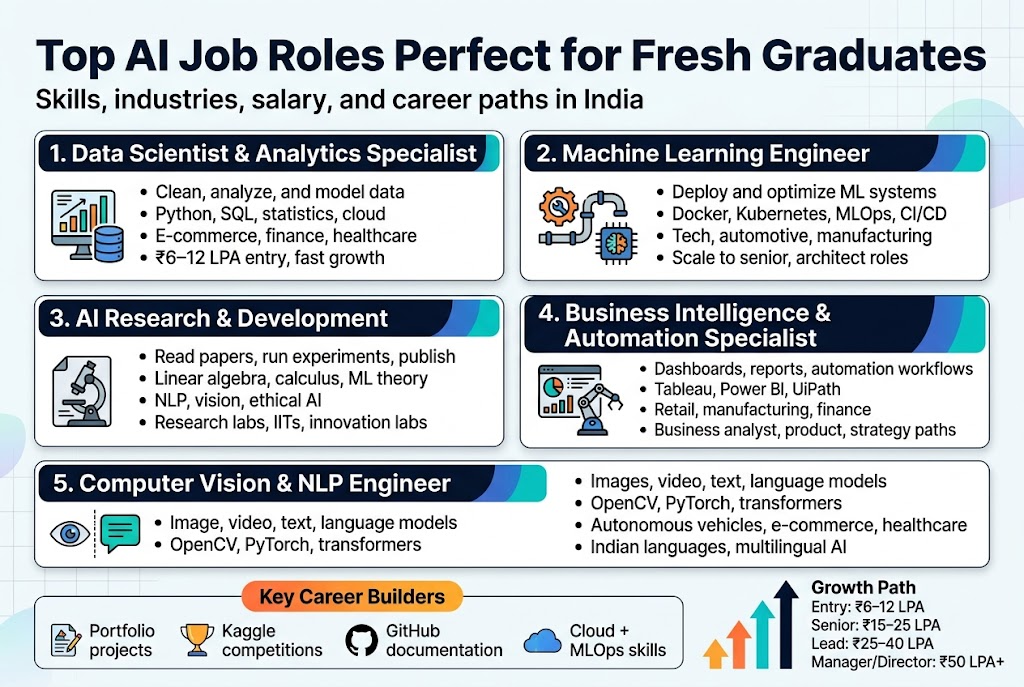
Entry-level data scientists in India can expect starting salaries between ₹6-12 lakhs per annum, with premium companies and startups offering higher packages. Bangalore, Mumbai, and Pune typically offer the highest compensation due to the concentration of tech companies.
Career progression in data science follows a clear path. After 2-3 years, you can advance to senior data scientist roles with salaries ranging from ₹15-25 lakhs. Lead data scientist positions command ₹25-40 lakhs, while data science managers and directors can earn ₹50 lakhs and above.
Many data scientists eventually transition into specialized roles like ML engineers, AI researchers, or move into leadership positions as Chief Data Officers or VP of Analytics.
Portfolio Building and Project Ideas
Creating a strong portfolio distinguishes you from thousands of other candidates. Build projects that showcase end-to-end data science workflows, from data collection and cleaning to model deployment and monitoring.
Consider working on real-world problems like predicting house prices using publicly available real estate data, analyzing social media sentiment around brand mentions, or building recommendation systems using movie rating datasets. Document your process clearly on GitHub with well-commented code and detailed README files.
Kaggle competitions provide excellent opportunities to practice your skills while learning from the global data science community. Even if you don't win, participating in competitions demonstrates your commitment to continuous learning and problem-solving abilities.
Machine Learning Engineer Opportunities
Machine learning engineering represents the bridge between data science research and production-ready AI systems. Companies across India desperately need professionals who can take ML models from experimental Jupyter notebooks to scalable, reliable systems serving millions of users daily.
Role Definition and Core Responsibilities
Machine learning engineers focus on the engineering aspects of ML systems rather than pure research or analysis. You'll work on model deployment, system architecture, performance optimization, and maintaining AI applications in production environments. This role requires strong software engineering skills combined with deep ML knowledge.
Your responsibilities include designing ML pipelines, implementing automated model training and retraining systems, monitoring model performance in production, and ensuring models scale efficiently under heavy load. You'll also collaborate closely with data scientists to productionize their experimental models and with DevOps teams to ensure smooth deployments.
Technical Skills and Infrastructure Knowledge
Python remains the primary programming language, but ML engineers need broader technical skills. Understanding containerization with Docker, orchestration with Kubernetes, and CI/CD pipelines becomes crucial when deploying models at scale.
MLOps tools and practices are essential for modern ML engineers. Familiarity with platforms like MLflow, Kubeflow, or AWS SageMaker helps manage the complete ML lifecycle from experimentation to production. You should understand version control for both code and data using tools like DVC (Data Version Control) or Git LFS.
Cloud platforms knowledge goes beyond basic familiarity. ML engineers need deep understanding of cloud-native ML services, auto-scaling configurations, and cost optimization strategies. Each major cloud provider offers specialized ML services that can significantly reduce development time and infrastructure complexity.
Database technologies extend beyond SQL to include NoSQL databases, data lakes, and real-time streaming platforms. Understanding how to efficiently store and retrieve training data, feature stores, and model artifacts becomes critical for building robust ML systems.
Industry Demand and Application Areas
Technology companies lead the demand for ML engineers in India. Companies like Google, Microsoft, Amazon, and Indian unicorns like Ola, Swiggy, and Byju's continuously hire ML engineers to power their core products and services.
Automotive companies developing autonomous vehicle technology need ML engineers to work on computer vision systems, sensor fusion, and real-time decision-making algorithms. Companies like Tata Motors and Mahindra are investing heavily in AI-powered vehicle systems.
Manufacturing companies implementing Industry 4.0 initiatives hire ML engineers to build predictive maintenance systems, quality control automation, and supply chain optimization solutions. Large manufacturers like Reliance Industries and L&T are at the forefront of this transformation.
Deployment and Production Challenges
Moving ML models from development to production involves numerous challenges that distinguish ML engineering from traditional software development. Model drift, where performance degrades over time due to changing data patterns, requires sophisticated monitoring and retraining systems.
Real-time inference requirements demand careful optimization of model serving infrastructure. You might need to implement techniques like model quantization, pruning, or knowledge distillation to reduce latency while maintaining accuracy.
Data pipeline reliability becomes critical since ML models depend heavily on consistent, high-quality input data. Building robust data validation, anomaly detection, and fallback mechanisms ensures your ML systems remain operational even when upstream data sources experience issues.
Career Growth and Specialization Paths
ML engineers can specialize in various directions based on their interests and industry demands. Some focus on specific domains like computer vision, natural language processing, or recommendation systems, developing deep expertise in particular algorithms and techniques.
Platform engineering represents another specialization path, where you build internal ML platforms and tools used by data science teams across the organization. These roles often involve creating self-service ML infrastructure that enables rapid experimentation and deployment.
Senior ML engineers often transition into ML architect roles, designing system architectures for complex AI applications. These positions require broad technical knowledge, excellent communication skills, and the ability to make strategic technology decisions that impact entire organizations.
AI Research and Development Roles
AI research and development positions offer fresh graduates the opportunity to work on cutting-edge technology that shapes the future of artificial intelligence. These roles blend academic research with practical application, making them perfect for candidates passionate about pushing the boundaries of what AI can achieve.
Research Environment and Expectations
AI research roles in India span across corporate research labs, government institutions, and academia-industry partnerships. Companies like Google Research India, Microsoft Research, IBM Research, and indigenous companies like TCS Innovation Labs actively hire fresh graduates for research positions.
Research work involves reading and understanding recent academic papers, reproducing experimental results, and developing novel approaches to existing problems. You'll spend significant time coding experimental prototypes, running extensive experiments, and documenting your findings for publication or patent applications.
Unlike product development roles, research positions allow for longer-term projects with uncertain outcomes. Success is measured not just by immediate results but by contributions to the broader AI knowledge base through publications, patents, or open-source contributions.
Academic Background and Prerequisites
Most AI research positions prefer candidates with strong mathematical foundations, including linear algebra, calculus, probability theory, and statistics. Computer science graduates with coursework in algorithms, data structures, and machine learning theory have significant advantages.
Research experience during undergraduate studies, even informal projects or internships, demonstrates your ability to work independently and tackle ambiguous problems. Participation in research conferences, hackathons, or AI competitions like Kaggle shows your engagement with the broader AI community.
Publication experience, while not mandatory for entry-level positions, significantly strengthens your application. Even co-authorship on undergraduate research projects or technical blog posts demonstrates your ability to communicate complex ideas clearly.
Current Research Areas and Trends
Natural language processing research in India focuses heavily on multilingual applications, given the country's linguistic diversity. Research labs work on developing AI systems that understand and generate content in Hindi, Tamil, Bengali, and other regional languages.
Computer vision research addresses uniquely Indian challenges like analyzing satellite imagery for agricultural applications, traffic pattern recognition in chaotic urban environments, or medical imaging analysis adapted for local healthcare systems.
Ethical AI and fairness research gains importance as AI systems impact billions of lives in India. Research teams work on developing algorithms that avoid bias, ensure privacy protection, and maintain transparency in decision-making processes.
Industry-Academic Collaboration Opportunities
Many companies partner with premier Indian institutions like IITs, IISc, and IIITs to conduct collaborative research. These partnerships offer fresh graduates the chance to work on industry-relevant problems while maintaining academic rigor and publication opportunities.
Government initiatives like the National Mission on Interdisciplinary Cyber-Physical Systems create opportunities for researchers to work on national-priority projects in areas like smart cities, digital agriculture, and healthcare AI.
International collaboration opportunities allow Indian researchers to work with global teams on cutting-edge projects. Companies often sponsor research exchanges, conference participation, and joint projects with international research institutions.
Publication and Patent Processes
Research roles expect regular publication of findings in peer-reviewed conferences and journals. Understanding the publication process, from paper writing to conference presentation, becomes essential for career advancement in research positions.
Patent filing represents another important aspect of industrial research. Learning to identify patentable innovations, write technical specifications, and navigate the intellectual property landscape adds value to your research contributions.
Open-source contributions often form part of research output, especially in areas like machine learning frameworks, datasets, or evaluation tools. Building a strong GitHub profile with well-documented research code helps establish your reputation in the research community.
Transitioning from Research to Product Development
Many researchers eventually transition into product development roles, bringing deep technical knowledge to practical applications. This transition requires developing additional skills in software engineering, system design, and product management.
Research experience provides unique advantages in product roles, including the ability to evaluate new technologies quickly, adapt cutting-edge research for practical applications, and solve complex technical challenges that don't have established solutions.
Some researchers choose entrepreneurial paths, founding startups based on their research innovations. The Indian startup ecosystem increasingly supports deep-tech companies built around AI research breakthroughs.
Business Intelligence and Automation Specialists
The intersection of AI and business intelligence creates exciting opportunities for fresh graduates who enjoy translating complex data into actionable business strategies. These roles combine technical skills with business acumen, making them perfect for candidates who want to directly impact organizational decision-making.
Role Scope and Business Impact
Business intelligence specialists use AI tools to analyze business performance, identify trends, and recommend strategic actions. You'll work closely with executives, department heads, and operational teams to understand their information needs and deliver insights that drive business growth.
Automation specialists focus on identifying and implementing AI-powered solutions to streamline business processes. This might involve deploying chatbots for customer service, implementing robotic process automation for data entry tasks, or building intelligent document processing systems.
These roles bridge the technical and business sides of organizations, requiring you to understand both the capabilities of AI technologies and the practical constraints of business operations.
Technical Tools and Platforms
Business intelligence platforms like Tableau, Power BI, and Qlik Sense form the foundation of modern BI work. These tools increasingly incorporate AI features like automated insight generation, natural language querying, and predictive analytics capabilities.
Automation platforms such as UiPath, Automation Anywhere, and Blue Prism enable the creation of software robots that can perform repetitive tasks traditionally done by humans. Understanding how to design, implement, and maintain these automation workflows becomes crucial.
Cloud-based BI and automation solutions dominate the market. Familiarity with platforms like Microsoft Power Platform, Google Analytics Intelligence, or AWS QuickSight helps you leverage pre-built AI capabilities rather than building everything from scratch.
Industry Applications and Use Cases
Retail companies use BI specialists to analyze customer behavior, optimize pricing strategies, and predict demand patterns. You might build dashboards that help store managers understand which products sell best at different times or automate inventory reordering based on sales trends.
Manufacturing companies employ automation specialists to implement predictive maintenance systems, quality control automation, and supply chain optimization. These applications directly impact operational efficiency and cost reduction.
Financial services organizations rely on BI specialists for risk assessment, fraud detection, and customer segmentation. Automation specialists in this sector often work on compliance reporting, loan processing automation, and customer onboarding workflows.
Business Process Understanding
Successful BI and automation specialists understand business processes deeply before applying technical solutions. You'll spend time shadowing employees, documenting current workflows, and identifying pain points that technology can address.
Change management skills become important since AI implementations often disrupt existing processes. You'll need to help employees adapt to new systems, provide training, and ensure smooth transitions from manual to automated processes.
Cost-benefit analysis capabilities help justify AI investments to leadership teams. Understanding how to calculate ROI, measure productivity improvements, and track business metrics ensures your technical solutions deliver measurable business value.
Stakeholder Communication and Presentation Skills
BI and automation specialists regularly present findings to non-technical audiences, requiring strong communication skills and the ability to translate complex technical concepts into business language.
Dashboard design and data visualization skills help you create compelling presentations that clearly communicate insights and recommendations. Understanding principles of visual design, cognitive psychology, and information hierarchy improves the impact of your work.
Executive reporting involves creating high-level summaries that help leadership teams make strategic decisions quickly. Learning to identify the most critical information and present it concisely becomes essential for career advancement.
Career Progression and Business Leadership Paths
Many BI and automation specialists eventually transition into business analyst, product management, or strategy consulting roles. The combination of technical skills and business understanding makes these professionals valuable for various leadership positions.
Some professionals choose to specialize further in specific domains like marketing analytics, operations research, or financial planning and analysis. Deep domain expertise combined with AI skills creates opportunities for senior specialist and director-level positions.
Entrepreneurial paths include starting consulting firms that help small and medium businesses implement AI-powered BI and automation solutions. The growing demand for these services creates opportunities for independent professionals and small teams.
Computer Vision and NLP Engineer Positions
Computer vision and natural language processing represent two of the most exciting and rapidly growing areas within AI, offering fresh graduates opportunities to work on technology that directly interacts with human senses and communication.
Computer Vision Engineering Fundamentals
Computer vision engineers develop systems that can interpret and understand visual information from images and videos. This involves working with various algorithms for object detection, image classification, facial recognition, and scene understanding.
Modern computer vision relies heavily on deep learning architectures like Convolutional Neural Networks (CNNs), Vision Transformers, and specialized architectures for different tasks. You'll work with frameworks like OpenCV, TensorFlow, PyTorch, and specialized libraries for image processing and analysis.
Real-time processing requirements distinguish computer vision engineering from research. Your models need to process video streams, camera feeds, or image uploads quickly enough for practical applications while maintaining high accuracy.
NLP Engineering Core Concepts
Natural language processing engineers build systems that understand, interpret, and generate human language. This includes working on chatbots, translation systems, sentiment analysis tools, and document processing applications.
Transformer architectures and large language models dominate modern NLP work. Understanding how to fine-tune pre-trained models like BERT, GPT, or specialized models for specific languages becomes crucial for practical applications.
Text preprocessing, tokenization, and feature extraction remain important foundational skills. You'll also work with techniques for handling different languages, dialects, and domain-specific vocabularies relevant to Indian markets.
Industry Applications and Real-World Projects
Automotive companies hire computer vision engineers to work on autonomous driving systems, driver assistance features, and vehicle monitoring applications. Indian companies like Tata Motors and Mahindra invest heavily in these technologies for both domestic and international markets.
E-commerce platforms use computer vision for product image analysis, visual search capabilities, and augmented reality shopping experiences. Companies like Flipkart and Amazon India continuously improve their visual search and recommendation systems.
Healthcare applications include medical image analysis for radiology, pathology, and diagnostic assistance. Companies working with hospitals and diagnostic centers need computer vision engineers to build systems that help doctors make more accurate diagnoses.
Language-Specific Challenges in India
Working with Indian languages presents unique challenges and opportunities for NLP engineers. Hindi, Tamil, Telugu, and other regional languages have different grammatical structures, writing systems, and cultural contexts compared to English.
Code-mixing and multilingual content require specialized approaches since users often combine multiple languages in single sentences or documents. Building systems that handle this linguistic diversity becomes crucial for Indian market applications.
Low-resource language processing involves working with languages that have limited digital content or training data. This requires creative approaches like transfer learning, data augmentation, and cross-lingual model adaptation.
Technical Implementation and Deployment
Edge computing deployment becomes important for computer vision applications that need to work on mobile devices or embedded systems. Understanding optimization techniques like model quantization, pruning, and knowledge distillation helps create efficient deployments.
API development skills help you create services that other applications can use. Building RESTful APIs that serve computer vision or NLP models enables integration with web applications, mobile apps, and enterprise systems.
Performance monitoring and model maintenance ensure your systems continue working accurately as data patterns change over time. This includes implementing logging, error handling, and automated retraining systems.
Specialized Tools and Frameworks
Computer vision engineers work with specialized hardware like GPUs for training and inference, cameras and sensors for data collection, and edge devices for deployment. Understanding hardware constraints and optimization becomes important for practical applications.
Annotation tools and data labeling platforms help manage the large datasets required for training computer vision models. Experience with tools like Labelbox, Supervisely, or custom annotation workflows adds value to your skill set.
MLOps tools specifically designed for computer vision and NLP help manage the unique challenges of working with large models, extensive datasets, and complex preprocessing pipelines. Understanding these specialized tools improves your effectiveness in production environments.
Career Specialization Opportunities
Some engineers specialize in specific application domains like medical imaging, autonomous vehicles, or robotics. Deep expertise in particular domains often leads to senior engineering or research positions with specialized companies.
Product engineering roles focus on building consumer-facing applications that leverage computer vision or NLP capabilities. These positions require understanding user experience design, mobile development, and product management principles.
Research engineering positions combine research and development, working on improving existing algorithms while building practical applications. These roles often involve collaboration with academic institutions and publication of research findings.
The field continues evolving rapidly with new architectures, training techniques, and application areas emerging regularly. Staying current with research developments while building practical implementation skills creates numerous opportunities for career growth and specialization in these exciting areas of AI technology.
Leading Companies Hiring AI Freshers in India
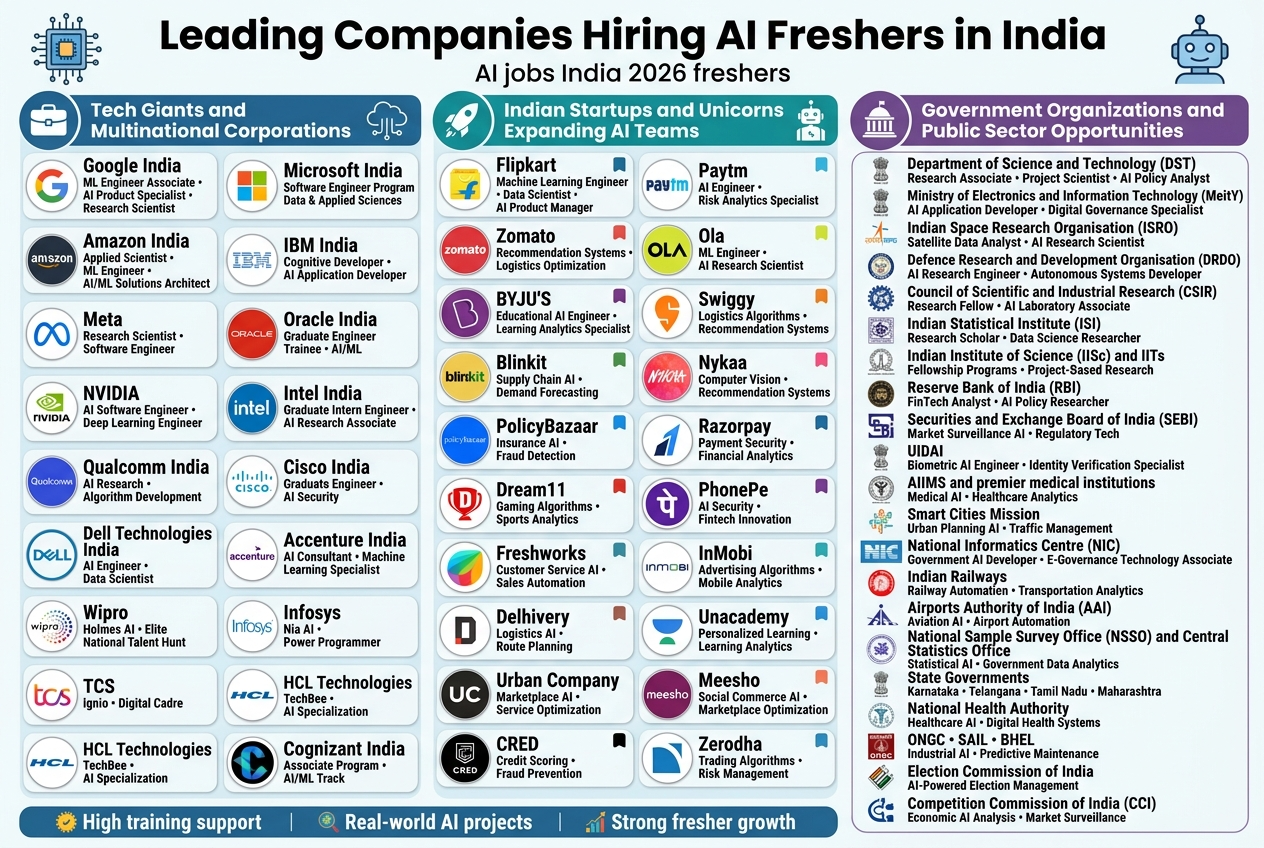
Tech Giants and Multinational Corporations
The landscape of AI jobs India 2026 freshers will be dominated by major technology companies that continue to expand their artificial intelligence capabilities across the country. These organizations offer the most comprehensive training programs, cutting-edge projects, and significant career growth opportunities for newcomers to the AI field.
Google India has positioned itself as a leader in AI research and development, with multiple offices across Bangalore, Hyderabad, and Gurgaon. The company actively recruits fresh graduates for roles in machine learning engineering, AI research, and product development. Their entry-level positions include Machine Learning Engineer Associate, AI Product Specialist, and Research Scientist positions specifically designed for recent graduates. Google's AI division works on everything from search algorithms to autonomous vehicles, offering freshers exposure to real-world applications that impact millions of users globally.
Microsoft India represents another powerhouse in the AI hiring space, with their Azure AI division constantly seeking new talent. The company's Hyderabad campus serves as their largest development center outside the United States, making it a prime destination for AI freshers. Microsoft offers specialized graduate programs like the Software Engineer program and the Data & Applied Sciences program, both of which have strong AI components. Fresh graduates can expect to work on projects involving natural language processing, computer vision, and cloud-based AI services.
Amazon India's AI initiatives span across multiple verticals, from Alexa development to AWS machine learning services. The company's Bangalore and Hyderabad offices house thousands of engineers working on AI-driven products and services. Amazon actively recruits through campus placements and offers roles such as Applied Scientist, Machine Learning Engineer, and AI/ML Solutions Architect for fresh graduates. Their comprehensive training programs help newcomers understand both the technical and business aspects of AI implementation.
IBM India has transformed its hiring strategy to focus heavily on AI and cloud computing roles. With the acquisition of Red Hat and their focus on hybrid cloud solutions powered by AI, IBM offers unique opportunities for freshers to work on enterprise-level AI solutions. Their entry-level programs include the Cognitive Developer role and AI Application Developer positions, where fresh graduates can learn to implement Watson-powered solutions for various industries.
Meta (formerly Facebook) continues to expand its AI research presence in India, with offices in Bangalore and Hyderabad focusing on computer vision, natural language processing, and recommendation systems. The company offers Research Scientist and Software Engineer roles specifically targeting fresh graduates with strong technical backgrounds. Meta's AI projects range from content moderation systems to augmented reality applications, providing diverse learning opportunities.
Oracle India has significantly increased its AI-related hiring, particularly for their cloud infrastructure and database solutions enhanced with machine learning capabilities. The company offers Graduate Engineer Trainee programs with specializations in AI and machine learning, focusing on developing enterprise-grade AI solutions for global clients.
NVIDIA's presence in India has grown substantially, especially with the AI boom in recent years. Their Bangalore office focuses on AI chip development, deep learning frameworks, and autonomous vehicle technologies. Fresh graduates can find opportunities in roles like AI Software Engineer, Deep Learning Engineer, and Hardware-Software Integration Specialist.
Intel India continues to be a major player in AI hardware and software development. With their recent focus on AI acceleration chips and edge computing solutions, the company offers various entry-level positions for AI enthusiasts. Their programs include Graduate Intern Engineer roles and AI Research Associate positions.
Qualcomm India's AI division works on mobile AI solutions, 5G integration with AI, and IoT applications. The company actively recruits fresh graduates for their AI research teams in Bangalore and Hyderabad, offering roles in algorithm development and mobile AI optimization.
Cisco India has expanded its AI capabilities significantly, particularly in network automation and security applications. The company offers Graduate Engineer programs with AI specializations, focusing on developing intelligent networking solutions and cybersecurity applications powered by machine learning.
Dell Technologies India continues to invest in AI research and development, particularly in areas like edge computing and data analytics. Their entry-level programs include AI Engineer roles and Data Scientist positions designed for fresh graduates looking to work on enterprise AI solutions.
Accenture India represents the consulting giant's commitment to AI transformation services. The company hires thousands of fresh graduates annually for their AI and analytics division, offering comprehensive training programs that combine technical skills with business acumen. Roles include AI Consultant, Machine Learning Specialist, and Cognitive Technology Associate.
Wipro has made significant investments in AI capabilities, launching their Holmes AI platform and establishing dedicated AI labs across India. The company's Elite National Talent Hunt program specifically targets AI and machine learning enthusiasts, offering roles in AI solution development and implementation for global clients.
Infosys continues to be a major recruiter of AI talent through their Mysore training center and various campus recruitment programs. The company's Nia AI platform requires constant innovation and fresh talent, making it an attractive destination for AI freshers. Their Power Programmer program includes specialized tracks for AI and machine learning.
Tata Consultancy Services (TCS) remains one of the largest recruiters of fresh graduates in the AI space. Their ignio platform and various AI initiatives across different industry verticals provide numerous opportunities for newcomers. TCS offers specialized training programs in AI and machine learning as part of their Digital Cadre program.
HCL Technologies has established several AI labs across India and actively recruits fresh talent for their AI and automation division. The company's TechBee program includes AI specializations, allowing even non-engineering graduates to enter the AI field with proper training.
Cognizant India focuses heavily on AI-driven digital transformation projects for global clients. Their Associate Program includes dedicated tracks for AI and machine learning, offering fresh graduates the opportunity to work on cutting-edge projects in various industries like healthcare, banking, and retail.
Indian Startups and Unicorns Expanding AI Teams
The startup ecosystem in India has become incredibly vibrant for AI jobs India 2026 freshers, with numerous unicorns and emerging companies building AI-first products and services. These organizations often provide more hands-on experience, faster career growth, and the opportunity to work on groundbreaking technologies from day one.
Flipkart, India's largest e-commerce platform, has made substantial investments in AI across multiple areas including recommendation engines, supply chain optimization, and fraud detection. The company actively recruits fresh graduates for their AI labs in Bangalore and other locations. Roles include Machine Learning Engineer, Data Scientist, and AI Product Manager positions specifically designed for recent graduates. Flipkart's AI initiatives span computer vision for product catalog management, natural language processing for customer service, and predictive analytics for inventory management.
Paytm has transformed into a fintech giant with AI at its core, powering everything from fraud detection to credit scoring. The company's Noida and Bangalore offices house dedicated AI teams working on payment security, loan approval systems, and customer behavior analytics. Fresh graduates can find opportunities in roles like AI Engineer, Risk Analytics Specialist, and Machine Learning Developer.
Zomato's AI applications range from food recommendation systems to delivery optimization algorithms. The company actively recruits fresh talent for their Gurgaon headquarters and Bangalore office, offering roles in recommendation systems development, computer vision for food recognition, and logistics optimization powered by machine learning.
Ola has positioned AI as central to its mobility platform, with applications in ride matching, pricing optimization, and autonomous vehicle development. The company's Bangalore office offers numerous opportunities for fresh graduates in roles such as Machine Learning Engineer for mobility solutions, AI Research Scientist, and Data Science Associate focusing on transportation analytics.
BYJU'S has revolutionized education technology with AI-powered personalized learning platforms. The company continuously recruits AI talent for developing adaptive learning algorithms, natural language processing for content creation, and computer vision for interactive learning experiences. Entry-level positions include Educational AI Engineer and Learning Analytics Specialist.
Swiggy utilizes AI extensively for food delivery optimization, restaurant recommendations, and demand forecasting. The company's Bangalore headquarters offers fresh graduates opportunities to work on logistics algorithms, recommendation systems, and customer behavior analysis through various AI-focused roles.
Grofers (now Blinkit) has built its quick commerce platform around AI-driven demand prediction and inventory management. The company recruits fresh talent for roles in supply chain AI, demand forecasting, and customer analytics, particularly focusing on real-time decision-making systems.
Nykaa has integrated AI across its beauty and fashion platforms for product recommendations, virtual try-on features, and inventory management. The company offers entry-level positions in computer vision, recommendation systems, and customer analytics for fresh graduates interested in AI applications in e-commerce.
PolicyBazaar uses AI for insurance recommendation engines, claim processing automation, and fraud detection. The company actively recruits fresh graduates for their AI teams in Gurgaon and Pune, offering roles in insurance technology AI development and financial services automation.
Razorpay has built AI capabilities around payment processing, fraud detection, and financial analytics. The company offers fresh graduates opportunities to work on fintech AI applications, including payment security algorithms and business intelligence systems.
Dream11 leverages AI for fantasy sports recommendations, user behavior analysis, and fraud prevention in gaming. The company recruits AI talent for developing gaming algorithms, user engagement optimization, and sports analytics applications.
PhonePe continues to expand its AI capabilities for payment security, user experience optimization, and financial services recommendations. The company offers entry-level positions in AI security, recommendation systems, and fintech innovation for fresh graduates.
Freshworks has built AI into its customer relationship management and help desk solutions. The company's Chennai and Bangalore offices offer opportunities for fresh graduates to work on customer service AI, sales automation, and business intelligence applications.
InMobi focuses on mobile advertising powered by AI and machine learning. The company recruits fresh talent for developing advertising algorithms, user behavior prediction systems, and mobile analytics solutions at their Bangalore headquarters.
Delhivery uses AI extensively for logistics optimization, route planning, and supply chain management. The company offers fresh graduates opportunities to work on logistics AI, delivery optimization algorithms, and warehouse automation systems.
Unacademy has integrated AI into its education platform for personalized learning paths, content recommendations, and student performance analytics. The company recruits AI talent for educational technology development and learning analytics roles.
UrbanClap (now Urban Company) applies AI for service provider matching, demand prediction, and quality assurance. The company offers entry-level positions in marketplace AI, recommendation systems, and service optimization for fresh graduates.
Meesho utilizes AI for social commerce optimization, seller recommendations, and fraud detection. The company recruits fresh talent for e-commerce AI development, social media analytics, and marketplace optimization roles.
CRED has built AI capabilities around credit scoring, financial recommendations, and fraud prevention. The company offers fresh graduates opportunities to work on fintech AI applications and credit analytics systems.
Zerodha applies AI for trading algorithms, risk management, and customer analytics in their fintech platform. The company recruits AI talent for developing trading technology and financial analytics solutions.
Government Organizations and Public Sector Opportunities
The Indian government has recognized AI as a strategic priority, leading to numerous opportunities for AI jobs India 2026 freshers in public sector organizations. These positions often provide job security, comprehensive benefits, and the chance to work on projects that directly impact citizens' lives across the country.
The Department of Science and Technology (DST) has established multiple AI initiatives, including the National Mission on Interdisciplinary Cyber-Physical Systems. The organization regularly recruits fresh graduates through various programs, offering roles such as Research Associate, Project Scientist, and AI Policy Analyst. These positions involve working on national-level AI strategy development, research coordination, and technology implementation across government departments.
The Ministry of Electronics and Information Technology (MeitY) leads India's digital transformation initiatives, with AI playing a central role. The ministry recruits fresh talent for its various AI projects, including the National AI Portal development, digital governance solutions, and citizen service automation. Entry-level positions include AI Application Developer, Digital Governance Specialist, and Technology Policy Associate roles.
The Indian Space Research Organisation (ISRO) has significantly increased its AI applications in satellite data analysis, mission planning, and space exploration. The organization conducts regular recruitment drives for fresh engineers and scientists to work on AI-powered space applications. Roles include Satellite Data Analyst, AI Research Scientist for space applications, and Mission Planning Specialist positions that combine space technology with artificial intelligence.
The Defence Research and Development Organisation (DRDO) actively recruits AI talent for developing autonomous systems, cybersecurity solutions, and strategic technology applications. Fresh graduates can find opportunities in roles such as AI Research Engineer, Autonomous Systems Developer, and Defence Technology Specialist. These positions involve working on cutting-edge military applications of AI while contributing to national security.
The Council of Scientific and Industrial Research (CSIR) operates multiple laboratories across India that conduct AI research for various applications. The organization recruits fresh graduates through the CSIR-NET program and direct recruitment for positions like Research Fellow, AI Laboratory Associate, and Technology Development Specialist. These roles span diverse areas from healthcare AI to industrial automation.
The Indian Statistical Institute (ISI) continues to be a premier destination for AI and machine learning research. The institute recruits fresh graduates for research positions focusing on theoretical and applied aspects of artificial intelligence. Opportunities include Research Scholar positions, Data Science Researcher roles, and Statistical AI Analyst positions.
The Indian Institute of Science (IIScience) and Indian Institutes of Technology (IITs) offer numerous research and development positions for AI freshers. These institutions recruit through various fellowship programs and project-based positions, allowing fresh graduates to work on cutting-edge AI research while pursuing advanced degrees.
The Reserve Bank of India (RBI) has embraced AI for regulatory technology, fraud detection, and financial system monitoring. The central bank recruits fresh graduates for their technology division, offering roles such as FinTech Analyst, AI Policy Researcher, and Digital Banking Specialist positions that combine finance with artificial intelligence applications.
The Securities and Exchange Board of India (SEBI) utilizes AI for market surveillance, fraud detection, and regulatory compliance monitoring. The organization recruits technology graduates for roles in market surveillance AI, regulatory technology development, and financial crime detection systems.
The Unique Identification Authority of India (UIDAI) continues to enhance Aadhaar services with AI applications for biometric authentication, fraud prevention, and service optimization. The organization recruits fresh graduates for roles such as Biometric AI Engineer, Identity Verification Specialist, and Digital Identity Analyst positions.
All India Institute of Medical Sciences (AIIMS) and other premier medical institutions have begun recruiting AI specialists for healthcare applications. These institutions offer opportunities for fresh graduates to work on medical AI, diagnostic systems, and healthcare analytics through various research and development positions.
The Smart Cities Mission under the Ministry of Urban Development recruits AI talent for developing intelligent city solutions. Fresh graduates can find opportunities in urban planning AI, traffic management systems, and citizen service automation across various participating cities.
The National Informatics Centre (NIC) serves as the technology backbone for government digital services and actively recruits AI talent for developing citizen-centric applications. The organization offers roles such as Government AI Developer, Digital Service Specialist, and E-Governance Technology Associate for fresh graduates.
The Indian Railways has begun implementing AI solutions for predictive maintenance, passenger services, and operational optimization. The organization recruits fresh graduates through various technical services for roles in railway automation, passenger service AI, and transportation analytics.
The Airports Authority of India (AAI) uses AI for air traffic management, security systems, and passenger service optimization. The organization offers opportunities for fresh graduates in aviation AI, airport automation, and passenger experience enhancement roles.
The National Sample Survey Office (NSSO) and Central Statistics Office utilize AI for data analysis, survey automation, and statistical modeling. These organizations recruit fresh graduates for roles in statistical AI, survey technology, and government data analytics positions.
State governments across India have also established AI initiatives, creating opportunities at the regional level. States like Karnataka, Telangana, Tamil Nadu, and Maharashtra have dedicated AI policies and recruit fresh talent for state-specific AI projects through their respective public service commissions and direct recruitment processes.
The National Health Authority, responsible for Ayushman Bharat digital mission, recruits AI professionals for healthcare technology development, patient data analytics, and health service optimization. Fresh graduates can find opportunities in healthcare AI, medical data analysis, and digital health system development.
Public sector enterprises like Oil and Natural Gas Corporation (ONGC), Steel Authority of India Limited (SAIL), and Bharat Heavy Electricals Limited (BHEL) have begun incorporating AI into their operations, creating new opportunities for fresh graduates in industrial AI applications, predictive maintenance, and operational optimization.
The Election Commission of India has started exploring AI applications for election management, voter services, and electoral process optimization. The organization periodically recruits technology professionals for developing AI-powered election management systems and voter engagement platforms.
The Competition Commission of India (CCI) uses AI for market analysis, antitrust investigations, and economic research. The organization recruits fresh graduates for roles in economic AI analysis, market surveillance, and competition policy research that leverage artificial intelligence and machine learning techniques.


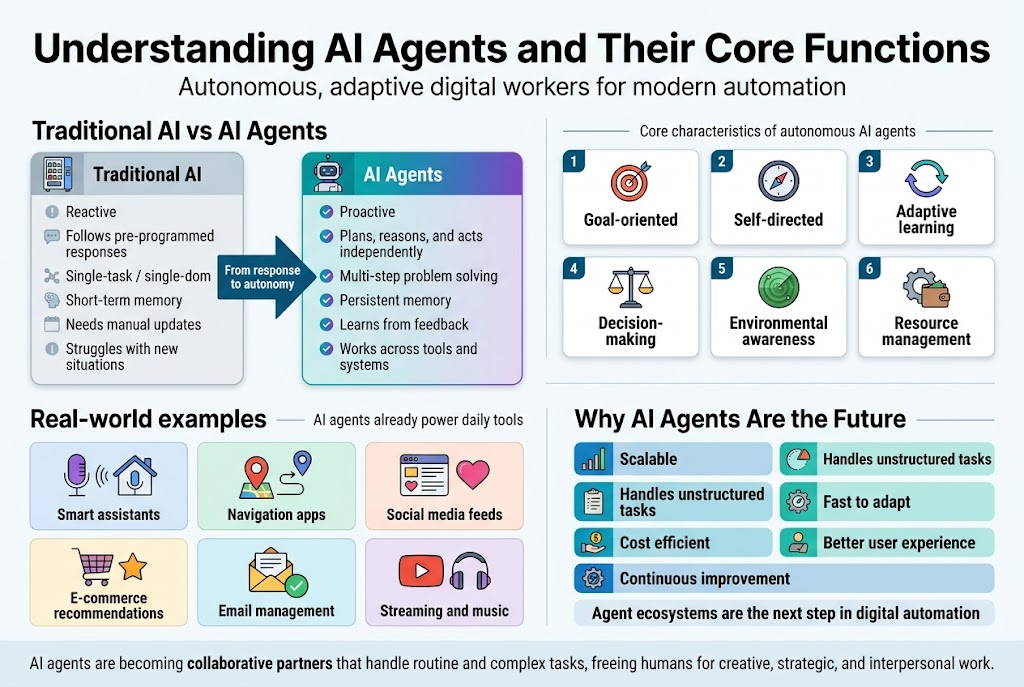

Comments (0)