

AI Agents Kya Hain 2026 - Agentic AI Complete Guide India
AI Agents Kya Hain 2026 - India mein Agentic AI ka complete guide. Jaaniye AI agents kya hain, kaise kaam karte hain, aur 2026 mein India ke liye kya opportunities hain.
 Rate the Images
AI Agents Kya Hain 2026 - Agentic AI Complete Guide India
AI agents are changing how businesses work across India, and 2026 is shaping up to be the year when agentic AI becomes mainstream. These smart digital assistants can handle complex tasks, make decisions, and work independently - going way beyond simple chatbots or automation tools.
This complete guide is perfect for business owners, tech professionals, and anyone curious about AI agents India 2026 and what agentic AI kya hai really means. You'll get practical insights whether you're running a startup in Bangalore or managing operations for a large company in Mumbai.
We'll break down the different types of AI agents that are already transforming industries like healthcare, finance, and retail across India. You'll also discover how to actually build and implement these agents for your own business, plus what exciting trends are coming next in the Indian AI landscape.
Ready to understand how AI agents can give your business a competitive edge in 2026? Let's dive in.
Understanding AI Agents and Their Core Functions
What Are AI Agents and How They Differ from Traditional AI
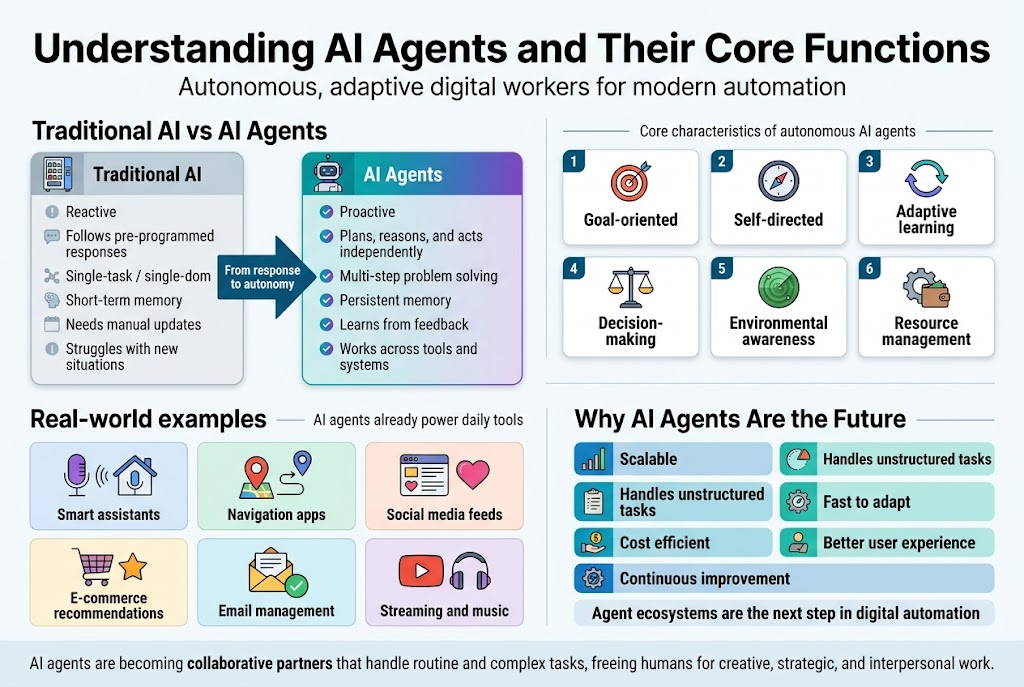
AI agents represent a significant leap forward from the traditional AI systems we've known. When most people think about AI, they picture chatbots that respond to queries or recommendation engines that suggest movies. These conventional AI systems are reactive - they wait for input, process it, and provide an output. But AI agents kya hai? They're something entirely different.
Think of AI agents as digital workers who don't need constant supervision. Unlike traditional AI that follows pre-programmed responses, these agents can think, plan, and execute tasks independently. They're like having a smart assistant who not only understands what you want but also figures out the best way to get it done.
Traditional AI systems work like vending machines - you input something specific, and you get a predetermined output. If you ask a traditional chatbot "What's the weather?" it searches its database and tells you the temperature. But an AI agent would understand that you might be asking because you're planning to go out, so it could check the weather, suggest what to wear, remind you to take an umbrella if it's going to rain, and even book you a cab if the weather looks bad.
The key difference lies in their approach to problem-solving. Traditional AI systems are like following a recipe step by step. AI agents India 2026 are moving toward something more like having a chef who understands your dietary preferences, checks what's in your fridge, and creates a completely new dish that you'll love.
Here's where it gets really interesting - AI agents can learn from their mistakes and improve their performance over time. If a traditional AI system makes an error, someone needs to manually update its programming. But AI agents analyze what went wrong, understand the cause, and adjust their approach for next time.
The difference also shows up in how they handle uncertainty. Traditional AI systems often break down when faced with situations they weren't specifically trained for. AI agents, however, can reason through new scenarios using their understanding of similar situations. They're comfortable with ambiguity and can make reasonable decisions even when they don't have all the information.
Another crucial distinction is their ability to work with multiple tools and systems simultaneously. Traditional AI typically operates within a single domain - a language model processes text, an image recognition system handles pictures, and so on. AI agents can combine multiple capabilities, switching between different tools as needed to accomplish their goals.
Memory also works differently in AI agents. Traditional AI systems often have short-term memory - they forget context between conversations or sessions. AI agents maintain persistent memory, learning about your preferences, past interactions, and ongoing projects. This allows them to provide increasingly personalized and effective assistance over time.
The interaction style is fundamentally different too. With traditional AI, you need to learn how to communicate with the system - using specific commands or phrasing your requests in particular ways. AI agents adapt to your communication style, understanding context, implied meanings, and even emotional undertones in your requests.
Key Characteristics That Make AI Agents Autonomous
Autonomy in AI agents comes from several core characteristics that work together to create truly independent digital entities. The most fundamental of these is goal-oriented behavior. Unlike systems that simply respond to commands, AI agents understand objectives and work toward achieving them.
When you tell an AI agent to "increase sales for the quarter," it doesn't just wait for you to specify every step. Instead, it breaks down this high-level goal into smaller, actionable tasks. It might analyze current sales data, identify underperforming products, research market trends, create targeted marketing strategies, and monitor results - all while keeping the ultimate objective in mind.
Self-direction is another critical characteristic. AI agents can initiate actions without explicit instructions. They proactively identify opportunities, spot problems before they become serious, and take corrective measures. This is like having a team member who not only does their assigned work but also notices when something needs attention and takes care of it.
Adaptive learning sets AI agents apart from static systems. They continuously update their understanding based on new experiences and feedback. When an agent tries a particular approach to solve a problem and it doesn't work as expected, the agent doesn't just fail - it learns why the approach didn't work and develops better strategies for similar situations in the future.
Decision-making capability is perhaps the most impressive characteristic of autonomous AI agents. They can evaluate multiple options, weigh pros and cons, consider various factors, and make informed choices. This isn't just about picking the option with the highest score in some calculation. AI agents can consider context, timing, resources, and even potential risks when making decisions.
Environmental awareness is what allows AI agents to understand their operating context. They know what tools and resources are available to them, understand the constraints they're working within, and can adapt their behavior based on changing conditions. If an agent is working with a limited budget, it automatically factors this into its decision-making process.
The ability to handle multi-step processes autonomously is another key characteristic. AI agents can manage complex workflows that involve multiple stages, decision points, and potential branching paths. They keep track of where they are in the process, what still needs to be done, and how to adjust if circumstances change.
Communication and collaboration capabilities allow AI agents to work effectively with humans and other AI systems. They can explain their reasoning, ask for clarification when needed, provide updates on their progress, and coordinate with other agents or team members to achieve shared goals.
Persistence is a characteristic that often gets overlooked but is crucial for autonomous operation. AI agents don't give up when they encounter obstacles. They try alternative approaches, seek additional resources, or escalate to humans when necessary. This persistence, combined with their learning ability, means they become better at overcoming challenges over time.
Error handling and recovery are built into autonomous AI agents. When something goes wrong, they don't just crash or stop working. They assess the situation, determine what went wrong, and either fix the problem themselves or find workarounds to continue making progress toward their goals.
Resource management is another important autonomy characteristic. AI agents understand their limitations - whether in terms of computational resources, time, budget, or access to information. They allocate these resources efficiently and can prioritize tasks based on importance and available resources.
Real-World Examples of AI Agents You Already Use
Many people are already interacting with AI agents without realizing it. These systems have become so integrated into our daily lives that we often don't recognize their sophisticated capabilities.
Smart home assistants like Amazon's Alexa or Google Assistant are prime examples of AI agents in action. When you ask Alexa to "play relaxing music for studying," it doesn't just search for songs with those keywords. The agent considers your past music preferences, the time of day, your typical study sessions, and even your calendar to curate an appropriate playlist. It might dim smart lights, adjust the temperature, and set a focus timer - all without being explicitly asked to do these things.
Navigation apps like Google Maps and Waze operate as location-based AI agents. They don't just calculate the shortest route between two points. These agents continuously monitor traffic conditions, road closures, accidents, and even weather conditions to dynamically adjust your route. They learn your driving patterns, understand your preferences for highways versus city streets, and can predict where you're likely going based on your location and time of day.
Social media platforms use AI agents extensively to curate your feed. The agent behind Instagram's algorithm doesn't randomly show posts. It analyzes your interaction patterns, the time you spend looking at different types of content, your relationships with other users, and current trending topics to create a personalized experience. This agent is constantly learning and adjusting based on your behavior.
E-commerce recommendation engines are sophisticated AI agents working behind the scenes. When you're shopping on Amazon, the agent doesn't just look at your purchase history. It considers items you've viewed, how long you spent looking at them, products you've added to your wishlist, seasonal trends, and even what similar customers have bought. The agent might notice you're browsing kitchen appliances and proactively suggest complementary items or alert you to limited-time offers.
Email management systems increasingly use AI agents to help organize your inbox. Gmail's Smart Reply and Smart Compose features analyze the content and context of your emails to suggest appropriate responses or help you write messages more efficiently. These agents learn your communication style and can even detect urgent emails that might need immediate attention.
Banking and financial apps employ AI agents for fraud detection and financial planning. These agents monitor your spending patterns, detect unusual transactions, and can even predict future cash flow needs. Some banking agents proactively suggest ways to save money or alert you to subscription services you might have forgotten about.
Streaming services like Netflix and Spotify use AI agents to create personalized recommendations. These agents don't just look at what you've watched or listened to before. They analyze when you consume content, what devices you use, whether you finish what you start, and even factors like the weather or current events to suggest content that matches your mood and situation.
Customer service chatbots have evolved into sophisticated AI agents that can handle complex inquiries. Modern customer service agents can access your account history, understand the context of your problem, escalate issues appropriately, and even follow up to ensure your issue was resolved satisfactorily.
Ride-sharing apps like Uber and Ola use AI agents to optimize the entire transportation network. These agents predict demand in different areas, position drivers strategically, calculate dynamic pricing, and match riders with appropriate drivers based on multiple factors including location, destination, driver ratings, and vehicle type.
Smart fitness trackers and health apps employ AI agents that monitor your activity patterns, sleep quality, and health metrics to provide personalized recommendations. These agents can detect changes in your routine, suggest workout modifications based on your progress, and even remind you to take breaks or get more sleep.
Investment and trading platforms use AI agents to monitor markets, analyze trends, and even execute trades on behalf of users. These agents can process vast amounts of financial data in real-time, identify opportunities, and make split-second decisions that would be impossible for human traders.
Why AI Agents Are the Future of Digital Automation
The evolution toward AI agents represents a fundamental shift in how we approach automation and problem-solving in digital environments. Traditional automation tools require explicit programming for every scenario and break down when faced with unexpected situations. AI agents, however, bring intelligence and adaptability that makes them far more capable of handling the complexities of real-world operations.
Scalability is one of the primary reasons why agentic AI represents the future of automation. Traditional automated systems require significant human oversight and maintenance. When you need to handle more volume or add new capabilities, you typically need to invest substantial time and resources in reprogramming and testing. AI agents can scale their operations naturally, learning to handle increased complexity and volume without proportional increases in human intervention.
The ability to handle unstructured and unpredictable tasks sets AI agents apart from conventional automation. Traditional automation works well for repetitive, well-defined processes. But real business environments are full of exceptions, edge cases, and unexpected scenarios. AI agents thrive in these conditions because they can reason through novel situations and find appropriate solutions.
Cost efficiency becomes apparent when you consider the total cost of ownership for automation solutions. While AI agents might require higher initial investment, they reduce long-term operational costs significantly. They need less maintenance, can handle more diverse tasks, and become more efficient over time through learning. Traditional automation systems often require expensive upgrades or complete replacements when business needs change.
Integration capabilities make AI agents particularly valuable in complex technological environments. Modern businesses use dozens of different software tools and systems. Traditional automation often struggles with integration challenges and requires custom development for each connection. AI agents can learn to work with new tools and systems, often without requiring specialized programming for each integration.
The speed of adaptation is another compelling advantage. When market conditions change or new requirements emerge, traditional automation systems might take months to update. AI agents can adapt to new conditions much more quickly, often learning new patterns and adjusting their behavior in days or weeks rather than months.
Continuous improvement is built into AI agents in ways that traditional automation cannot match. Conventional automated systems perform the same way indefinitely unless someone manually improves them. AI agents continuously analyze their performance, identify optimization opportunities, and implement improvements autonomously.
The complexity of modern business operations demands the sophistication that AI agents provide. Today's organizations deal with multiple time zones, diverse customer bases, complex supply chains, and rapidly changing market conditions. AI agents can manage this complexity in ways that traditional automation simply cannot.
User experience improvements are driving adoption of AI agents across various sectors. Customers and employees increasingly expect intelligent, personalized interactions rather than rigid, scripted responses. AI agents can provide the flexibility and responsiveness that modern users demand while maintaining the efficiency benefits of automation.
Risk management capabilities give AI agents significant advantages over traditional automation. They can identify potential problems before they occur, assess the likelihood and impact of various risks, and take preventive measures. Traditional automation systems typically only respond to problems after they've already occurred.
Resource optimization is another area where AI agents excel. They can dynamically allocate computational resources, adjust to varying workloads, and optimize performance based on changing conditions. This leads to better resource utilization and lower operational costs compared to traditional automation approaches.
The convergence of multiple technologies is making AI agents more powerful and practical. Advances in natural language processing, computer vision, machine learning, and cloud computing are combining to create agents with unprecedented capabilities. This technological convergence is accelerating and will continue to expand what AI agents can accomplish.
Data-driven insights generated by AI agents provide additional value beyond task automation. As agents work, they gather valuable information about processes, user behaviors, and system performance. This data can inform strategic decisions and identify optimization opportunities that might not be apparent through traditional automation approaches.
The growing complexity of cybersecurity threats requires the adaptive intelligence that AI agents provide. Traditional security automation relies on predefined rules and signatures that quickly become outdated. AI agents can recognize new types of threats, adapt their defensive strategies, and coordinate sophisticated responses to complex security incidents.
As AI agents India 2026 continues to evolve, we're seeing the emergence of agent ecosystems where multiple AI agents collaborate to achieve complex objectives. This represents a shift from isolated automation tools to integrated intelligent systems that can handle enterprise-level challenges.
The democratization of AI agent technology is making these capabilities accessible to smaller organizations that previously couldn't afford sophisticated automation solutions. Cloud-based AI agent platforms are reducing the technical barriers and upfront costs associated with implementing intelligent automation.
Looking ahead, the integration of AI agents with emerging technologies like quantum computing, 5G networks, and edge computing will create even more powerful automation capabilities. These agents will be able to process information faster, make more sophisticated decisions, and operate with greater autonomy than ever before.
The shift toward AI agents represents more than just technological evolution - it's a fundamental change in how we think about the relationship between humans and machines in work environments. Rather than replacing human workers, AI agents are becoming collaborative partners that handle routine and complex tasks, freeing humans to focus on creative, strategic, and interpersonal work.
This transformation is already underway across industries, and organizations that embrace AI agent technology early are gaining significant competitive advantages. The future belongs to businesses that can effectively leverage the autonomous, adaptive, and intelligent capabilities that AI agents provide.
Types of AI Agents Transforming Industries in 2026
Reactive Agents for Instant Response Systems
Picture walking into a bank and having your questions answered instantly, or calling customer service and getting immediate solutions without waiting on hold for hours. That's the magic of reactive agents, and they're becoming the backbone of instant response systems across India in 2026.
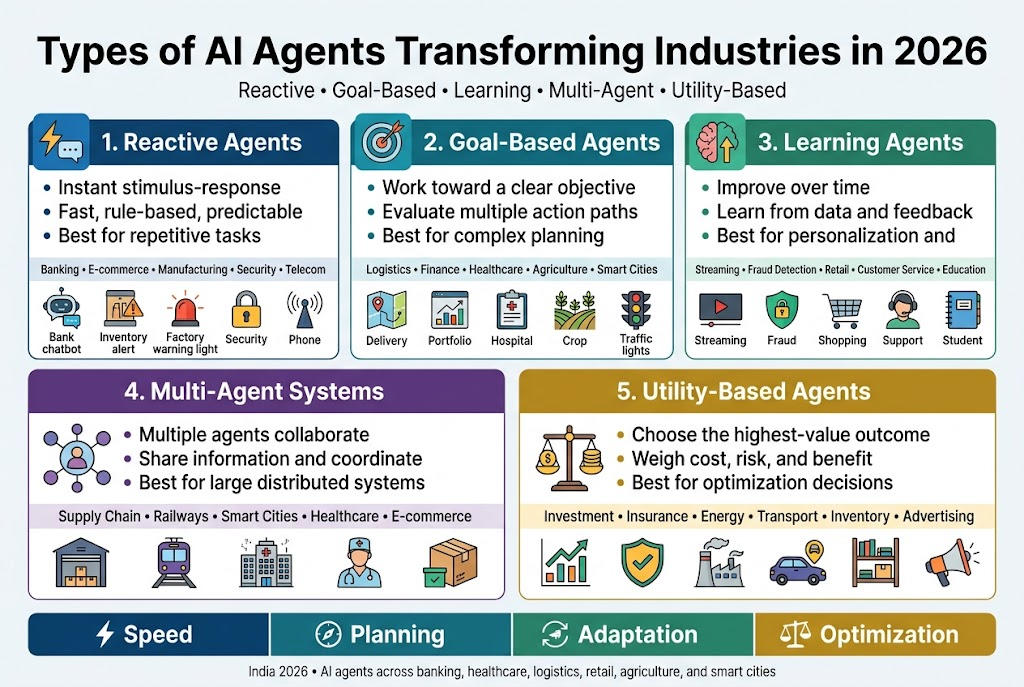
Reactive agents operate on pure stimulus-response patterns. They don't overthink or analyze past experiences – they simply react to what's happening right now based on their programmed rules. Think of them as the digital equivalent of reflexes. When something happens, they immediately know what to do because their responses are hardcoded into their system.
In the banking sector, reactive agents have revolutionized customer interactions. HDFC Bank's new AI chatbot can handle over 10,000 queries simultaneously, providing instant responses to common questions about account balances, transaction histories, and loan eligibilities. The agent doesn't need to "think" about each response – it recognizes patterns in customer queries and immediately fires back the appropriate information.
These agents excel in environments where speed matters more than complexity. E-commerce platforms like Flipkart and Amazon India use reactive agents to manage inventory alerts, price updates, and basic customer support. When a customer asks about delivery status or return policies, the agent instantly pulls the relevant information without any delay.
The beauty of reactive agents lies in their predictability and speed. They're perfect for handling repetitive tasks that don't require deep analysis or learning from past experiences. In manufacturing units across Gujarat and Tamil Nadu, reactive agents monitor production lines and immediately alert supervisors when parameters go beyond acceptable ranges. They don't analyze why something went wrong – they simply detect the problem and raise an alarm.
Healthcare applications have seen remarkable success with reactive agents. Hospitals in metros like Mumbai and Delhi use these agents to manage appointment bookings, send medication reminders, and provide basic health information. When a patient calls asking about visiting hours or emergency procedures, the agent responds immediately with accurate information.
However, reactive agents do have limitations. They can't adapt to new situations they haven't been programmed for, and they don't learn from interactions. If a customer asks a question that's slightly different from what the agent expects, it might struggle to provide a helpful response. Despite these limitations, their role in creating efficient, responsive systems makes them invaluable for businesses looking to provide instant customer service.
The integration of reactive agents with voice technology has opened new possibilities. Regional language support means customers can interact with these agents in Hindi, Tamil, Bengali, and other Indian languages. This has been particularly valuable in rural banking initiatives where customers prefer communicating in their local language rather than English.
Security applications represent another growing area for reactive agents. Smart building systems in IT parks across Bangalore and Hyderabad use reactive agents to control access, monitor surveillance feeds, and respond to security alerts. These agents can instantly lock doors, alert security personnel, or activate alarm systems when they detect unauthorized access attempts.
The telecommunications industry has embraced reactive agents for network management and customer service. Jio and Airtel use these agents to handle routine customer inquiries, process recharge requests, and manage network troubleshooting. When network issues arise, reactive agents immediately implement predetermined fixes or escalate issues to human technicians.
Goal-Based Agents for Complex Problem Solving
Goal-based agents represent a significant leap forward from their reactive counterparts. While reactive agents simply respond to immediate stimuli, goal-based agents have something more sophisticated – they understand what they're trying to achieve and can figure out different ways to reach their objectives.
These agents work with a clear understanding of their goals and can evaluate different action sequences to determine which approach will best help them achieve their targets. They're like having a dedicated problem-solver who not only knows what you want but can also figure out the best way to get there.
In India's rapidly evolving logistics sector, goal-based agents are transforming how companies manage complex delivery networks. Delhivery and Blue Dart use these agents to optimize delivery routes, manage warehouse operations, and coordinate multi-modal transportation. When tasked with delivering 10,000 packages across Mumbai in a single day, the agent doesn't just follow pre-set routes – it evaluates traffic patterns, weather conditions, vehicle availability, and delivery priorities to create the most efficient plan.
The financial services industry has found goal-based agents particularly valuable for investment management and risk assessment. Mutual fund companies like SBI Mutual Fund use these agents to create personalized investment portfolios. Given a client's financial goals, risk tolerance, and investment timeline, the agent evaluates hundreds of different investment combinations to recommend the optimal portfolio structure.
Manufacturing companies across India are deploying goal-based agents to manage production planning and quality control. Tata Steel uses sophisticated agents that understand production targets, raw material availability, energy costs, and market demand to optimize manufacturing schedules. When the goal is to produce 50,000 tons of steel while minimizing costs and maintaining quality standards, the agent evaluates various production scenarios to determine the best approach.
Healthcare applications showcase the life-changing potential of goal-based agents. Apollo Hospitals has implemented agents that assist doctors in treatment planning for complex cases. Given a patient's symptoms, medical history, and treatment goals, these agents can evaluate different treatment options, predict potential complications, and recommend the most effective treatment protocols.
Agricultural applications represent one of the most promising areas for goal-based agents in India. With over 600 million people dependent on agriculture, these agents are helping farmers maximize crop yields while minimizing resource usage. An agent tasked with maximizing wheat production on a 10-acre farm in Punjab evaluates soil conditions, weather forecasts, seed varieties, irrigation schedules, and fertilizer applications to create comprehensive farming plans.
Urban planning and smart city initiatives across India are leveraging goal-based agents to address complex infrastructure challenges. The Pune Smart City project uses agents to optimize traffic flow, manage energy distribution, and coordinate public services. When the goal is to reduce traffic congestion during peak hours, the agent evaluates different traffic signal timings, route diversions, and public transportation schedules to achieve the desired outcome.
The education sector has embraced goal-based agents for personalized learning experiences. BYJU'S and other edtech platforms use these agents to create customized learning paths for students. Given a student's current knowledge level, learning style, and academic goals, the agent designs personalized study plans that adapt based on the student's progress and performance.
E-commerce platforms like Myntra use goal-based agents for inventory management and demand forecasting. When the goal is to maintain optimal stock levels while minimizing holding costs, these agents evaluate sales patterns, seasonal trends, supplier lead times, and market conditions to make intelligent restocking decisions.
The real estate industry has started using goal-based agents to match buyers with properties and optimize pricing strategies. Companies like 99acres deploy agents that understand buyers' requirements, budget constraints, and preferences to identify the most suitable properties from thousands of available options.
Learning Agents That Improve Over Time
Learning agents represent the most sophisticated evolution in AI agent technology. Unlike their reactive or goal-based counterparts, these agents don't just execute predefined responses or solve specific problems – they actually get better at their jobs over time by learning from every interaction and experience.
These agents use machine learning algorithms to analyze patterns, identify what works and what doesn't, and continuously refine their approaches. They're like having an employee who not only does their job well but actively looks for ways to do it better every single day.
Netflix India's recommendation system exemplifies the power of learning agents. Every time you watch a movie, skip a trailer, or rate a show, the agent learns something new about your preferences. Over months and years, it builds an incredibly detailed understanding of what you like, when you like to watch, and what mood you might be in based on your viewing patterns. The more you interact with the platform, the better it gets at predicting what you'll want to watch next.
Banking institutions across India are deploying learning agents for fraud detection and risk management. ICICI Bank's fraud prevention system learns from every transaction, gradually building a more sophisticated understanding of what constitutes normal behavior for each customer. When someone tries to use your card in an unusual location or for an atypical purchase, the agent compares this against millions of similar patterns it has learned from other customers and historical data.
The retail sector has seen remarkable success with learning agents for demand forecasting and pricing optimization. Big Bazaar and other major retailers use agents that learn from sales data, seasonal patterns, economic indicators, and consumer behavior to predict what products will be in demand and at what prices. These agents don't just look at historical sales – they learn to recognize subtle patterns that human analysts might miss.
Customer service applications showcase the daily impact of learning agents on millions of Indians. Zomato's customer support agent learns from every complaint, query, and resolution to provide better service over time. When customers report issues with delivery times, food quality, or restaurant availability, the agent doesn't just solve the immediate problem – it learns patterns that help prevent similar issues in the future.
Healthcare applications demonstrate the life-saving potential of learning agents. Diagnostic systems used in hospitals across India learn from thousands of medical cases to improve their accuracy in identifying diseases and recommending treatments. These agents analyze medical images, lab results, and patient symptoms, learning from each case to become more accurate at detecting conditions like cancer, heart disease, and neurological disorders.
Agricultural learning agents are transforming farming practices across rural India. These agents learn from weather patterns, soil conditions, crop yields, and farming techniques to provide increasingly accurate guidance to farmers. An agent working with farmers in Karnataka learns from both successful and failed harvests to recommend optimal planting times, irrigation schedules, and pest control measures.
The transportation industry has embraced learning agents for route optimization and traffic management. Uber and Ola use agents that learn from traffic patterns, passenger behavior, and driver preferences to optimize ride allocation and pricing. These agents continuously adjust their algorithms based on real-world data to reduce waiting times and improve overall service efficiency.
Educational platforms leverage learning agents to personalize the learning experience for millions of students. Unacademy's learning agents analyze how students interact with content, which topics they find challenging, and what teaching methods work best for different learning styles. Over time, these agents develop increasingly sophisticated approaches to help each student learn more effectively.
The manufacturing sector uses learning agents to optimize production processes and predict maintenance needs. Reliance Industries employs agents that learn from equipment performance data, production quality metrics, and maintenance records to predict when machines might fail and optimize production schedules accordingly.
Financial trading platforms use sophisticated learning agents that analyze market patterns, news events, and trading behaviors to make investment decisions. These agents process vast amounts of data from global markets, learning to identify opportunities and risks that human traders might miss.
Social media platforms like Instagram use learning agents to curate personalized feeds and detect harmful content. These agents learn from user interactions, engagement patterns, and content preferences to show users the most relevant posts while filtering out spam, misinformation, and inappropriate content.
Multi-Agent Systems for Collaborative Tasks
Multi-agent systems represent a paradigm shift from individual AI agents working in isolation to multiple agents collaborating and coordinating to achieve complex objectives. Think of it as the difference between having one super-smart employee versus having a team of specialists who can work together seamlessly.
These systems involve multiple autonomous agents that can communicate with each other, share information, negotiate roles and responsibilities, and coordinate their actions to accomplish tasks that would be impossible for any single agent to handle effectively. Each agent might have different capabilities, knowledge, or areas of expertise, but together they form a powerful collective intelligence.
Supply chain management represents one of the most successful applications of multi-agent systems in India. Walmart India uses a sophisticated network of agents to manage its complex supply chain operations. One agent specializes in demand forecasting, another manages inventory levels, a third coordinates with suppliers, and others handle logistics and delivery scheduling. These agents constantly communicate with each other, sharing information about stock levels, delivery schedules, and market demands to optimize the entire supply chain operation.
The Indian Railways has implemented multi-agent systems to manage train scheduling, passenger reservations, and maintenance operations across the vast network. Different agents handle ticket booking, route optimization, crew scheduling, and maintenance planning. When a train is delayed, agents coordinate to adjust schedules, inform passengers, arrange alternate transportation, and minimize disruption across the network.
Smart city initiatives across India showcase the potential of multi-agent systems for urban management. Surat's smart city project uses multiple agents to manage traffic lights, monitor air quality, coordinate emergency services, and optimize energy consumption. Traffic management agents communicate with pollution monitoring agents to adjust signal timings when air quality deteriorates, while emergency service agents coordinate with traffic agents to clear routes for ambulances and fire trucks.
Financial trading platforms employ sophisticated multi-agent systems where different agents specialize in various aspects of trading. Some agents focus on market analysis, others on risk assessment, while specialized agents handle order execution and portfolio rebalancing. These agents work together to make split-second trading decisions, sharing insights and coordinating strategies to maximize returns while managing risk.
E-commerce platforms like Amazon India use multi-agent systems to manage complex marketplace operations. Product recommendation agents work with inventory management agents, pricing agents, and fraud detection agents to create seamless shopping experiences. When you browse for products, multiple agents collaborate behind the scenes – one analyzes your preferences, another checks inventory availability, a third calculates optimal pricing, and others ensure secure payment processing.
Healthcare systems across India are implementing multi-agent systems to coordinate patient care and hospital operations. AIIMS Delhi uses agents that specialize in appointment scheduling, diagnostic coordination, treatment planning, and resource allocation. These agents work together to ensure patients receive timely care while optimizing hospital efficiency.
Manufacturing companies use multi-agent systems to coordinate complex production processes. Bajaj Auto employs agents that manage different aspects of motorcycle production – some handle parts procurement, others manage assembly line operations, while specialized agents coordinate quality control and shipping. These agents communicate continuously to ensure smooth production flow and timely delivery.
Agricultural cooperatives are implementing multi-agent systems to support farmers across different regions. These systems include agents specializing in crop monitoring, weather prediction, market pricing, and logistics coordination. Farmers in different states can benefit from collective intelligence as agents share information about successful farming techniques, market conditions, and optimal timing for planting and harvesting.
The entertainment industry uses multi-agent systems to coordinate complex film and television productions. Production houses employ agents that manage scheduling, budget allocation, resource coordination, and post-production workflows. These agents ensure that actors, crew members, equipment, and locations are coordinated efficiently throughout the production process.
Telecommunications companies like Bharti Airtel use multi-agent systems to manage network operations across India. Different agents handle network monitoring, traffic optimization, maintenance scheduling, and customer service coordination. When network issues arise, these agents work together to identify problems, implement fixes, and communicate with customers about service disruptions.
Gaming platforms employ multi-agent systems to create dynamic and engaging gameplay experiences. Different agents manage player matching, game balance, virtual economy management, and anti-cheat mechanisms. These agents collaborate to ensure fair gameplay while maintaining engaging experiences for millions of players.
Utility-Based Agents for Optimized Decision Making
Utility-based agents represent the pinnacle of rational decision-making in AI systems. These agents don't just work toward goals or learn from experience – they make decisions by evaluating the utility or value of different outcomes and choosing the option that maximizes their overall benefit or satisfaction.
These agents use mathematical models to assign numerical values to different possible outcomes, considering multiple factors and trade-offs simultaneously. They're like having a decision-maker who can weigh dozens of different considerations instantly and choose the option that provides the best overall value.
Investment management represents one of the most sophisticated applications of utility-based agents in India's financial sector. Mutual fund companies like HDFC AMC use these agents to make portfolio decisions by evaluating the utility of different investment options. The agent considers expected returns, risk levels, market volatility, liquidity requirements, and investor preferences to calculate the utility of each possible investment and construct portfolios that maximize expected utility for different investor profiles.
Insurance companies across India employ utility-based agents for risk assessment and pricing decisions. LIC uses agents that evaluate the utility of insuring different applicants by considering age, health status, lifestyle factors, financial background, and historical claims data. These agents calculate premiums that balance the company's need for profitability with competitive market pricing and customer acquisition goals.
Energy sector applications showcase the environmental and economic benefits of utility-based agents. NTPC uses sophisticated agents to optimize power generation across its network of plants. These agents evaluate the utility of different generation scenarios by considering fuel costs, environmental impact, grid demand, transmission losses, and maintenance requirements. The result is an optimal generation schedule that minimizes costs while meeting environmental standards and grid stability requirements.
Transportation optimization demonstrates the daily impact of utility-based agents on millions of Indians. Ola uses agents that evaluate ride requests by considering passenger pickup and drop locations, driver availability, traffic conditions, surge pricing effects, and driver earnings potential. The agent calculates the utility of different driver-passenger matches to optimize both customer satisfaction and driver income.
Agricultural decision-making has been revolutionized by utility-based agents that help farmers optimize their cultivation strategies. These agents evaluate the utility of different crop choices by considering soil conditions, weather forecasts, market prices, input costs, water availability, and risk factors. Farmers in states like Punjab and Maharashtra use these systems to make informed decisions about what to plant, when to plant, and how to manage their resources for maximum profitability.
Healthcare resource allocation represents one of the most critical applications of utility-based agents. Hospital systems use these agents to optimize bed allocation, surgery scheduling, and staff deployment by evaluating the utility of different resource allocation scenarios. The agents consider patient urgency, treatment effectiveness, resource availability, and cost considerations to make decisions that maximize overall patient welfare within budget constraints.
Retail inventory management showcases the commercial success of utility-based agents in optimizing complex business operations. Big Bazaar uses agents that evaluate the utility of different inventory levels by considering demand forecasts, holding costs, stockout risks, seasonal variations, and supplier constraints. These agents help maintain optimal inventory levels that maximize profits while minimizing the risk of stockouts or excessive inventory costs.
Urban planning applications demonstrate the potential of utility-based agents to address complex societal challenges. Smart city projects in Pune and Bhopal use agents that evaluate utility of different infrastructure development scenarios by considering population growth, traffic patterns, environmental impact, construction costs, and citizen satisfaction. These agents help city planners make informed decisions about where to build roads, schools, hospitals, and other public facilities.
Manufacturing optimization shows how utility-based agents can improve industrial efficiency across India. Tata Steel uses agents that evaluate the utility of different production schedules by considering raw material costs, energy prices, labor availability, demand forecasts, and quality requirements. These agents help optimize production planning to maximize profitability while maintaining product quality and delivery commitments.
Real estate investment platforms employ utility-based agents to help investors make property investment decisions. These agents evaluate properties by considering location factors, rental yields, appreciation potential, market trends, and investment goals to recommend properties that maximize utility for different investor profiles.
Educational resource allocation benefits from utility-based agents that help optimize learning experiences for students. Universities use agents that evaluate course offerings, faculty assignments, and resource allocation by considering student preferences, learning outcomes, faculty expertise, and budget constraints to maximize overall educational utility.
The logistics industry uses utility-based agents to optimize delivery networks and warehouse operations. Companies like Delhivery employ agents that evaluate different delivery routes and warehouse strategies by considering delivery speed, cost efficiency, fuel consumption, and customer satisfaction to maximize overall operational utility.
Marketing and advertising platforms use utility-based agents to optimize ad placements and campaign strategies. These agents evaluate different advertising options by considering target audience reach, engagement probability, conversion rates, and advertising costs to maximize return on advertising investment for businesses across India.
Agentic AI Technology and Its Revolutionary Capabilities
How Agentic AI Processes Information Independently
Agentic AI represents a massive shift from traditional AI systems that simply respond to commands. Think of conventional AI like a really smart calculator - you input data, it processes according to pre-programmed rules, and gives you an output. Agentic AI, on the other hand, works more like having an intelligent colleague who can think through problems, gather information from multiple sources, and come up with solutions without you having to spell out every single step.
The core difference lies in how these systems handle information processing. Traditional AI agents India 2026 will see operating in basic customer service roles follow simple if-then logic trees. You ask about your account balance, the system follows a predetermined path to fetch and display that information. But agentic AI kya hai becomes clear when you see how it approaches the same scenario differently. An agentic AI customer service system doesn't just pull your balance - it analyzes your spending patterns, notices you're asking about balance more frequently, cross-references this with your payment history, and proactively suggests budget management tools or alerts you to unusual spending patterns.
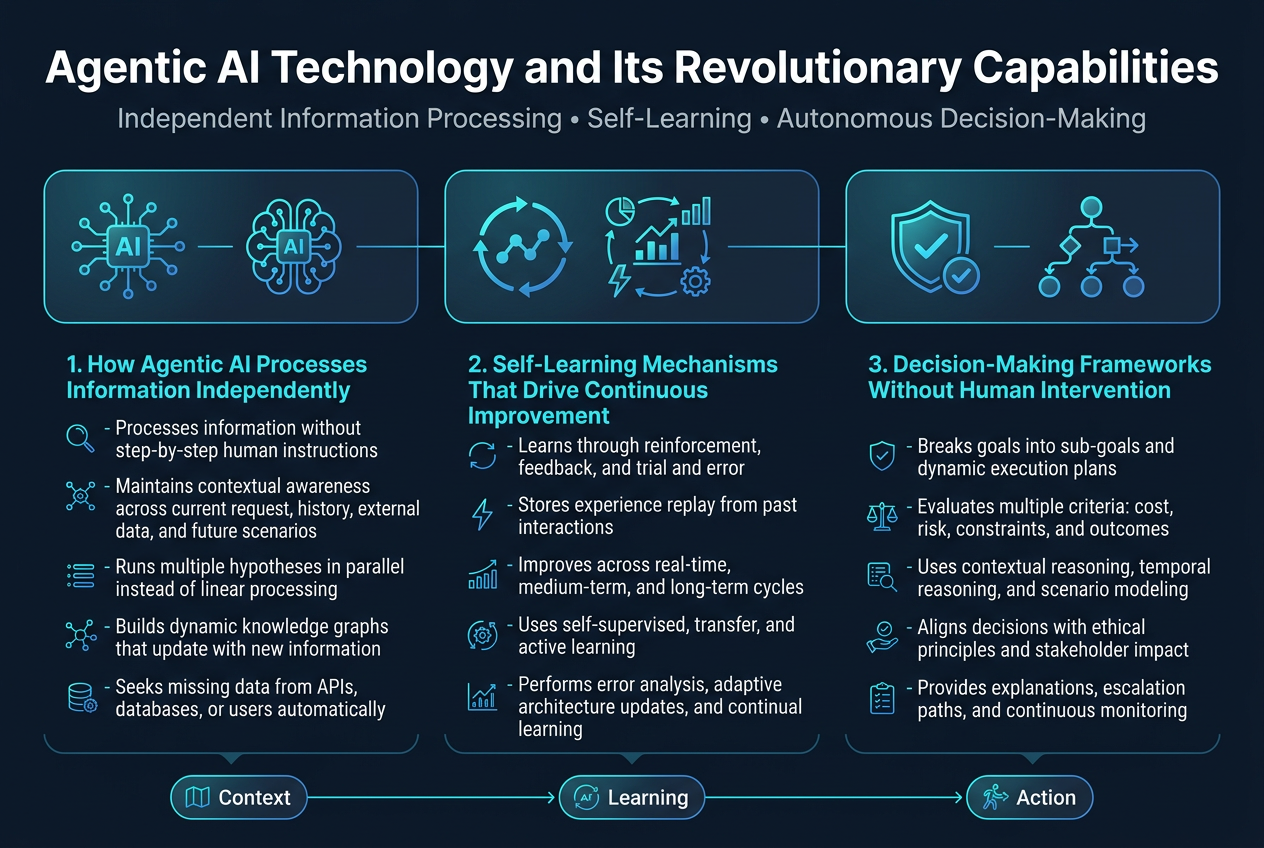
This independent processing capability stems from several sophisticated mechanisms working together. The system maintains what researchers call "contextual awareness" - a dynamic understanding of the current situation that goes beyond just the immediate query. When you interact with an agentic AI system, it's simultaneously processing your current request, your historical interactions, relevant external data, and potential future scenarios.
The information processing pipeline in agentic AI involves multiple parallel streams. The system doesn't just process information linearly like reading a book from start to finish. Instead, it creates multiple hypotheses about what you're trying to achieve and tests these against available data simultaneously. This parallel processing allows the AI to catch nuances and connections that sequential processing might miss.
Consider how an agentic AI system handles a complex business query. When a user asks about "quarterly performance," the system doesn't just pull up a standard report. It analyzes which quarter they're likely referring to based on the current date, their role in the company, recent projects they've been involved with, and market conditions during that period. It then assembles a comprehensive response that might include financial metrics, but also contextual factors like market trends, competitor analysis, and forward-looking insights.
The knowledge representation within these systems goes far beyond simple databases. Agentic AI creates dynamic knowledge graphs that connect information in meaningful ways. These aren't static connections like traditional databases with fixed relationships. The AI continuously updates and restructures these connections based on new information and changing contexts.
Memory management in agentic AI systems works on multiple levels. There's immediate working memory for current tasks, episodic memory for specific interactions and experiences, and semantic memory for general knowledge and learned patterns. The system can draw from all these memory types simultaneously to inform its current processing.
The independence in information processing also comes from the system's ability to seek out additional information when needed. Unlike traditional systems that work only with provided data, agentic AI can identify knowledge gaps and actively work to fill them. This might involve accessing external databases, APIs, or even requesting additional information from users in a natural, conversational way.
Pattern recognition in agentic AI operates at multiple abstraction levels simultaneously. While processing a request about customer retention, the system might recognize patterns at the individual customer level (this person's behavior suggests they're likely to churn), at the segment level (customers in this demographic show seasonal variation), and at the macro level (market conditions are affecting retention across all segments).
The real power of independent information processing becomes apparent in complex, multi-step scenarios. An agentic AI system managing inventory for a retail business doesn't just track current stock levels. It processes weather data to predict demand changes, analyzes social media trends to spot emerging product interests, monitors supplier reliability metrics, and factors in economic indicators that might affect purchasing power. All of this happens autonomously, without human operators having to set up these connections manually.
Data fusion capabilities allow agentic AI to combine information from disparate sources in intelligent ways. The system can take structured data from databases, unstructured text from documents, visual information from images or videos, and real-time feeds from IoT devices, then create a unified understanding that informs its decision-making.
Self-Learning Mechanisms That Drive Continuous Improvement
The self-learning capabilities of agentic AI represent one of its most transformative aspects. These systems don't just execute predefined algorithms - they actively improve their performance through experience, much like how humans learn from mistakes and successes.
The foundation of self-learning in agentic AI rests on multiple interconnected mechanisms. Reinforcement learning forms the backbone, where the system learns through trial and error, receiving feedback on its actions and adjusting future behavior accordingly. But modern agentic AI goes far beyond simple reinforcement learning by incorporating meta-learning capabilities - essentially learning how to learn more effectively.
Experience replay mechanisms allow the system to revisit past interactions and extract new insights. When an agentic AI system handles a customer service inquiry, it doesn't just solve the immediate problem and move on. It stores the entire interaction context, the solution path taken, the customer's response, and the ultimate outcome. Later, during quiet periods or dedicated learning cycles, the system analyzes these stored experiences to identify patterns and improvement opportunities.
The continuous improvement process operates on multiple timescales. Real-time learning happens during each interaction, where the system makes immediate micro-adjustments based on feedback signals. This might be as simple as noticing that a customer seems confused by a particular explanation and immediately adjusting the communication style. Medium-term learning occurs through batch processing of recent experiences, identifying trends and patterns that emerge over days or weeks. Long-term learning involves deep analysis of historical data to extract strategic insights and major capability improvements.
Self-supervised learning mechanisms enable agentic AI to find patterns and structure in data without explicit labels or training examples. The system can observe how successful interactions unfold and automatically identify the key factors that contributed to success. This is particularly powerful in complex business environments where the definition of "success" might be nuanced and context-dependent.
Transfer learning capabilities allow insights gained in one domain to inform performance in related areas. An agentic AI system that learns effective communication strategies while handling technical support queries can apply these insights when dealing with sales inquiries or account management tasks. This cross-pollination of knowledge accelerates learning across the entire system.
The self-learning process includes sophisticated error analysis and correction mechanisms. When something goes wrong, the system doesn't just note the failure - it conducts a detailed post-mortem to understand the failure modes. Was it a data quality issue? A reasoning error? A knowledge gap? Based on this analysis, the system can implement targeted improvements.
Adaptive architecture allows the learning system to modify its own structure based on performance needs. If the system discovers that certain types of queries require more complex reasoning, it can dynamically allocate more computational resources to those processing pathways. This self-modification capability means the system becomes more efficient over time, not just more knowledgeable.
Collaborative learning emerges when multiple agentic AI systems share insights and experiences. In a large organization deploying multiple AI agents across different departments, these systems can learn from each other's experiences. The customer service AI might share insights about customer communication preferences with the sales AI, while the sales AI shares knowledge about customer needs and pain points.
The self-learning mechanisms also incorporate uncertainty quantification - the system learns to recognize when it doesn't know something and responds appropriately. This might involve seeking additional information, escalating to human operators, or clearly communicating the limitations of its knowledge to users.
Active learning strategies enable the system to identify the most valuable learning opportunities. Rather than randomly sampling new experiences, the AI can focus on scenarios where learning would have the greatest impact on performance. This targeted approach to learning makes the improvement process much more efficient.
Continual learning techniques prevent the common problem of "catastrophic forgetting" where learning new tasks causes performance degradation on previously learned tasks. Agentic AI systems maintain their existing capabilities while acquiring new ones, creating a cumulative learning effect that builds expertise over time.
The learning process includes sophisticated feedback loop management. The system learns to distinguish between different types of feedback - immediate user responses, business outcome metrics, and long-term performance indicators - and weights them appropriately in its learning algorithms.
Decision-Making Frameworks Without Human Intervention
Autonomous decision-making represents the pinnacle of agentic AI capabilities. These systems can evaluate complex situations, weigh multiple factors, and make decisions that align with organizational goals and constraints without requiring human approval for each choice.
The decision-making framework operates through a multi-layered architecture that mirrors human cognitive processes while leveraging computational advantages. At the highest level, the system maintains strategic objectives and value alignment principles that guide all decisions. These aren't rigid rules but flexible frameworks that can adapt to changing circumstances while maintaining core principles.
Goal decomposition and planning form the foundation of autonomous decision-making. When faced with a complex objective, the system breaks it down into manageable sub-goals, identifies dependencies between different tasks, and creates dynamic execution plans. Unlike traditional project management tools, agentic AI continuously updates these plans based on changing conditions and new information.
Multi-criteria decision analysis allows the system to evaluate options across multiple dimensions simultaneously. When determining inventory levels, the system might consider cost factors, demand forecasts, storage constraints, supplier reliability, market trends, and opportunity costs all at once. The framework can handle trade-offs between competing objectives and find optimal solutions that balance multiple concerns.
Real-time risk assessment mechanisms enable the system to evaluate potential consequences before taking action. The AI doesn't just choose the option with the highest expected return - it considers the full distribution of possible outcomes, including low-probability but high-impact scenarios. This risk-aware decision-making helps prevent catastrophic failures and ensures robust performance across various conditions.
Contextual reasoning allows the system to adapt its decision-making approach based on the specific situation. The same underlying objective might require different strategies in different contexts. An agentic AI managing customer relationships might adopt a more conservative approach during economic uncertainty while being more aggressive during periods of growth and stability.
The decision framework incorporates temporal reasoning, understanding how decisions made now will affect future options and outcomes. The system can delay immediate gratification for long-term benefits or make strategic investments that won't pay off immediately but position the organization for future success.
Stakeholder impact analysis ensures that autonomous decisions consider their effects on various parties. The AI doesn't optimize for a single metric in isolation but considers how decisions affect customers, employees, partners, and other stakeholders. This holistic approach helps prevent solutions that solve one problem while creating others.
Constraint satisfaction mechanisms ensure that autonomous decisions remain within acceptable boundaries. These constraints might be hard limits (regulatory requirements, budget caps) or soft preferences (brand guidelines, cultural considerations). The system learns to operate effectively within these constraints rather than simply avoiding them.
Dynamic priority management allows the system to adjust its decision-making criteria based on changing circumstances. During a crisis, the AI might prioritize stability and risk reduction. During growth periods, it might emphasize opportunity identification and expansion. These priority shifts happen automatically based on environmental indicators and organizational signals.
The decision-making process includes sophisticated scenario modeling capabilities. Before making major decisions, the system can simulate potential outcomes under different assumptions and conditions. This mental modeling helps identify potential problems and opportunities that might not be immediately obvious.
Ethical reasoning frameworks ensure that autonomous decisions align with moral and ethical principles. The system doesn't just follow rules mechanically but can reason about ethical implications and make judgment calls in ambiguous situations. This capability becomes increasingly important as AI systems gain more autonomy and influence.
Explanation generation capabilities allow the system to articulate the reasoning behind its decisions. Even though the decisions are made autonomously, the AI can provide clear, logical explanations of why particular choices were made. This transparency builds trust and enables human oversight when needed.
Feedback integration mechanisms ensure that the decision-making framework improves over time. The system tracks the outcomes of its decisions and adjusts its decision-making models based on results. Poor decisions lead to framework refinements, while successful decisions reinforce effective patterns.
Escalation protocols define when autonomous decision-making should defer to human judgment. The system recognizes situations that exceed its competence or authority and can seamlessly transfer control to human operators while providing comprehensive context about the situation and decision factors involved.
The decision-making framework also handles uncertainty and incomplete information gracefully. Rather than waiting for perfect information that may never arrive, the system can make provisional decisions with built-in flexibility to adjust as more information becomes available.
Collaborative decision-making capabilities enable the AI to work with human team members and other AI systems when appropriate. The autonomous decision-making doesn't mean isolation - the system can recognize when collaboration would improve outcomes and initiate appropriate coordination mechanisms.
Resource allocation and optimization ensure that autonomous decisions make efficient use of available resources. The system understands resource constraints and can make decisions that maximize value while operating within these limitations.
The framework includes sophisticated monitoring and adjustment mechanisms that operate continuously in the background. The system doesn't just make a decision and move on - it monitors the implementation and outcomes, ready to adjust course if circumstances change or if the initial decision proves suboptimal.
This comprehensive decision-making capability represents the true promise of agentic AI technology - intelligent systems that can operate independently while remaining aligned with human values and organizational objectives. As these capabilities mature and become more widely deployed across Indian businesses in 2026, they will enable unprecedented levels of automation and optimization across industries.
AI Agent Applications Revolutionizing the Indian Market
Customer Service Automation in Indian Businesses
Indian companies are embracing AI agents to transform their customer service landscape, moving beyond traditional call centers to intelligent, multilingual support systems. These AI-powered solutions are handling everything from basic inquiries to complex problem-solving across multiple communication channels.
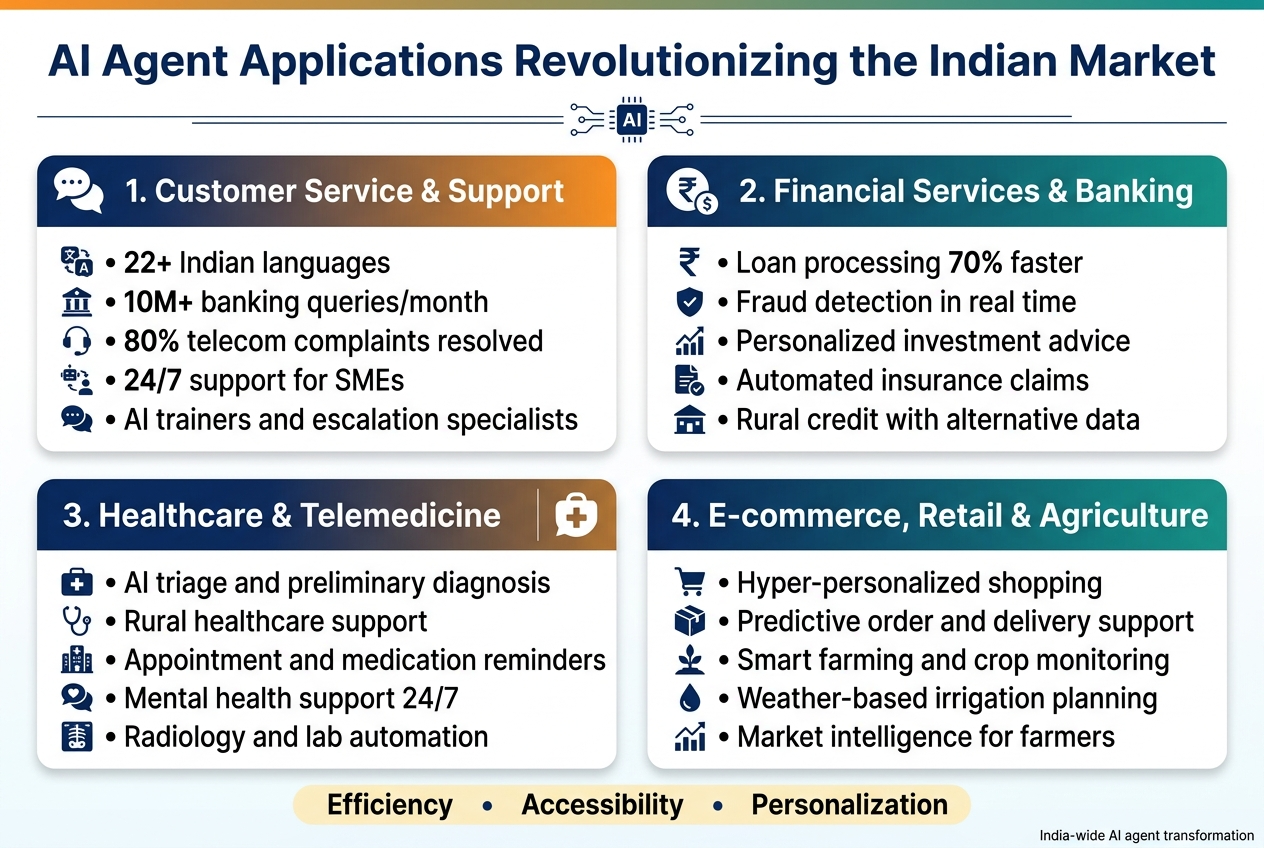
Major Indian corporations like Tata Consultancy Services, Infosys, and Reliance are deploying sophisticated AI agents that can communicate in over 22 Indian languages, including Hindi, Bengali, Tamil, Telugu, and Marathi. These systems understand regional dialects and cultural nuances, making customer interactions feel more personal and authentic.
The banking sector leads this transformation. ICICI Bank's virtual assistant handles over 10 million customer queries monthly, while State Bank of India's AI chatbot manages account inquiries, loan applications, and transaction disputes with remarkable accuracy. These systems reduce wait times from hours to seconds while maintaining high satisfaction rates.
Indian telecommunications companies are seeing dramatic improvements in customer experience. Bharti Airtel's AI agent resolves 80% of customer complaints without human intervention, handling everything from bill disputes to network issues. The system learns from each interaction, becoming more effective at predicting and solving problems before customers even report them.
E-commerce platforms are revolutionizing support through predictive AI agents. Flipkart and Amazon India deploy systems that anticipate customer needs based on browsing patterns, purchase history, and seasonal trends. These agents proactively reach out to customers about order updates, suggest relevant products, and resolve delivery concerns before they escalate.
The retail sector is experiencing a customer service revolution through AI agents integrated with inventory management systems. Big Bazaar and Reliance Retail use these systems to provide real-time product availability, price comparisons, and personalized recommendations across their physical and digital channels.
Small and medium enterprises are also benefiting from affordable AI agent solutions. Platforms like Haptik and Verloop provide cost-effective customer service automation that was previously only available to large corporations. These solutions help local businesses compete effectively by offering 24/7 customer support in multiple languages.
The impact extends beyond efficiency gains. AI agents in India are creating new job categories while transforming existing roles. Customer service representatives are evolving into AI trainers and escalation specialists, focusing on complex issues that require human empathy and creativity.
Real-world success stories demonstrate the power of AI agents in Indian customer service. Ola's AI system handles millions of ride requests daily, automatically resolving payment issues, route problems, and driver concerns. The platform's success stems from its ability to understand local transportation patterns and cultural expectations.
Food delivery platforms like Zomato and Swiggy use AI agents to manage order modifications, delivery tracking, and restaurant communications. These systems handle the complexity of Indian food preferences, dietary restrictions, and delivery logistics across diverse urban and rural areas.
Financial Services and Banking Applications
India's financial services sector is experiencing a dramatic transformation through AI agents, with applications spanning from automated loan processing to sophisticated fraud detection systems. These intelligent systems are making financial services more accessible to India's diverse population while maintaining strict security standards.
Public sector banks are leading the charge with AI agent implementations. Punjab National Bank's intelligent system processes loan applications 70% faster than traditional methods, analyzing creditworthiness through alternative data sources including social media activity, mobile usage patterns, and utility bill payments. This approach extends banking services to previously underserved populations without traditional credit histories.
Private sector financial institutions are deploying AI agents for wealth management and investment advisory services. HDFC Bank's AI system provides personalized investment recommendations based on customer financial behavior, risk tolerance, and market conditions. The system manages portfolios worth billions of rupees while offering advice traditionally available only to high-net-worth individuals.
Insurance companies are revolutionizing claims processing through AI agents. ICICI Lombard's intelligent system evaluates motor insurance claims in minutes rather than weeks, using image recognition to assess vehicle damage and cross-referencing repair costs across authorized service centers. The system handles over 70% of claims automatically, dramatically reducing processing times and costs.
Microfinance institutions are using AI agents to extend credit to rural populations. These systems analyze unconventional data sources like satellite imagery of farmlands, weather patterns, and crop yields to assess borrower creditworthiness. Companies like Grameen Foundation and SKS Microfinance are reaching previously unbankable populations through these intelligent systems.
Digital payment platforms are employing AI agents to prevent fraud while enabling seamless transactions. Paytm's AI system monitors millions of daily transactions, identifying suspicious patterns and blocking fraudulent activities in real-time. The system learns from each transaction, continuously improving its ability to distinguish between legitimate and suspicious activities.
Cryptocurrency exchanges are implementing AI agents to manage regulatory compliance and market monitoring. Platforms like WazirX and CoinSwitch Kuber use these systems to ensure adherence to India's evolving cryptocurrency regulations while providing automated trading strategies for users.
Stock brokerage firms are deploying AI agents for algorithmic trading and market analysis. Zerodha and Angel Broking offer AI-powered trading platforms that execute trades based on predetermined strategies, analyze market sentiment from news and social media, and provide real-time investment recommendations.
The Reserve Bank of India's regulatory sandbox allows financial institutions to test AI agent applications in controlled environments. This initiative is fostering innovation while ensuring consumer protection and systemic stability.
Non-banking financial companies are using AI agents to streamline operations and improve customer experiences. Bajaj Finserv's AI system manages everything from loan origination to collection activities, using predictive analytics to identify customers likely to default and implementing proactive intervention strategies.
Rural cooperative banks are adopting AI agents to bridge the technology gap. These systems help local bank employees serve customers more effectively by providing real-time guidance on loan procedures, regulatory requirements, and product recommendations suited to rural needs.
Healthcare and Telemedicine Advancements
Healthcare in India is being revolutionized by AI agents that bridge the gap between limited medical infrastructure and growing healthcare needs. These intelligent systems are making quality healthcare accessible to remote areas while supporting overworked medical professionals in urban centers.
Telemedicine platforms are deploying AI agents for preliminary diagnosis and triage. Practo and 1mg use intelligent systems that conduct initial patient assessments, asking relevant questions based on reported symptoms and medical history. These agents can identify urgent cases requiring immediate attention while routing routine inquiries to appropriate specialists.
Government healthcare initiatives are leveraging AI agents to extend medical services to rural areas. The Ayushman Bharat program incorporates AI systems that help community health workers diagnose common conditions, recommend treatments, and identify cases requiring referral to higher medical facilities. These agents operate effectively even with limited internet connectivity.
Hospitals are implementing AI agents for patient management and administrative tasks. Apollo Hospitals uses intelligent systems to manage appointment scheduling, medication reminders, and post-discharge care instructions. The AI agents coordinate between different departments, ensuring patients receive timely care while optimizing resource utilization.
Mental health platforms are using AI agents to provide accessible psychological support. Apps like Wysa and InnerHour deploy empathetic AI systems that offer cognitive behavioral therapy techniques, mood tracking, and crisis intervention. These agents provide 24/7 support in multiple Indian languages, addressing the significant shortage of mental health professionals.
Pharmaceutical companies are employing AI agents for drug discovery and clinical trial management. Indian firms like Dr. Reddy's and Cipla use these systems to identify potential drug compounds, predict side effects, and optimize clinical trial protocols. AI agents analyze vast databases of molecular structures and patient data to accelerate drug development timelines.
Medical imaging centers are deploying AI agents for radiology analysis. These systems assist radiologists in detecting abnormalities in X-rays, CT scans, and MRIs, significantly reducing diagnosis time while improving accuracy. Smaller hospitals and clinics can access expert-level diagnostic capabilities through these AI-powered systems.
Elderly care facilities are using AI agents to monitor patient health and medication compliance. These systems track vital signs through wearable devices, remind patients about medications, and alert healthcare providers about potential health emergencies. The agents learn individual patient patterns, providing personalized care recommendations.
Epidemic monitoring systems employ AI agents to track disease outbreaks and predict spread patterns. During the COVID-19 pandemic, these systems helped government agencies allocate medical resources effectively and implement targeted intervention strategies based on real-time data analysis.
Traditional medicine practitioners are integrating AI agents with Ayurvedic and Unani treatment approaches. These systems help practitioners access vast databases of traditional knowledge while ensuring treatments comply with modern safety standards. AI agents assist in creating personalized treatment plans that combine ancient wisdom with contemporary medical understanding.
Diagnostic laboratories are streamlining operations through AI agents that manage sample processing, result interpretation, and report generation. These systems reduce human errors while ensuring faster turnaround times for critical tests, particularly important in emergency medical situations.
E-commerce and Retail Personalization
India's booming e-commerce sector is being transformed by AI agents that deliver hyper-personalized shopping experiences tailored to diverse consumer preferences across the country. These intelligent systems understand regional tastes, cultural preferences, and individual buying patterns to create unique shopping journeys for each customer.
Amazon India's AI agents analyze millions of customer interactions daily, creating sophisticated buyer personas that go beyond basic demographics. The system considers factors like regional festivals, local weather patterns, and cultural events to time product recommendations perfectly. During Diwali season, the AI automatically adjusts inventory predictions and promotional strategies for different regions based on historical data and emerging trends.
Flipkart's AI-powered personalization engine processes customer behavior across multiple touchpoints, including mobile apps, website interactions, and customer service conversations. The system creates dynamic product recommendations that evolve throughout the shopping session, learning from each click, search, and purchase decision to refine suggestions in real-time.
Fashion e-commerce platforms are using AI agents to solve the complex challenge of style preferences across India's diverse fashion landscape. Myntra's AI system understands regional clothing preferences, seasonal variations, and individual style evolution. The agent considers factors like climate, cultural celebrations, and personal style history to suggest outfits that resonate with each customer's unique aesthetic.
Food delivery platforms are revolutionizing meal recommendations through AI agents that understand local culinary preferences. Zomato's intelligent system learns individual taste profiles while considering regional food habits, dietary restrictions, and meal timing patterns. The AI agent suggests restaurants and dishes based on weather conditions, time of day, and personal food journey.
Grocery delivery services are employing AI agents to predict household needs before customers realize them. BigBasket's system analyzes purchase patterns, seasonal consumption trends, and family size indicators to suggest replenishment schedules and new product trials. The AI considers factors like regional cooking styles and local ingredient availability.
Electronics retailers are using AI agents to simplify complex product selection processes. Croma and Reliance Digital deploy systems that understand technical specifications while translating them into user-friendly benefits. These agents ask simple questions about usage patterns and preferences to recommend products that match customer needs and budgets.
Small online retailers are accessing enterprise-level personalization through AI agent platforms. Services like Wigzo and WebEngage provide affordable AI solutions that help local businesses compete with major e-commerce platforms by offering personalized experiences previously available only to large corporations.
Social commerce platforms are integrating AI agents with social media behaviors to create community-driven shopping experiences. These systems analyze social interactions, influencer preferences, and peer recommendations to suggest products that align with customers' social circles and lifestyle aspirations.
Cross-border e-commerce platforms are using AI agents to navigate complex logistics and cultural preferences when serving Indian customers. These systems understand local delivery preferences, payment methods, and cultural sensitivities when recommending international products to Indian consumers.
Luxury retail platforms are deploying AI agents to provide personalized concierge services. These systems understand brand preferences, occasion-based shopping patterns, and individual style evolution to suggest high-end products that match customers' sophisticated tastes and social status considerations.
Agricultural Technology and Smart Farming
India's agricultural sector is experiencing a technological revolution through AI agents that help farmers optimize crop yields, manage resources efficiently, and adapt to changing climate conditions. These intelligent systems are making advanced farming techniques accessible to small-scale farmers while supporting large agricultural enterprises.
Crop monitoring systems use AI agents combined with satellite imagery and IoT sensors to track plant health across vast agricultural areas. Companies like CropIn and Intello Labs deploy systems that identify pest infestations, nutrient deficiencies, and disease outbreaks before they become visible to human observers. Farmers receive real-time alerts with specific recommendations for intervention strategies.
Weather prediction and agricultural planning platforms employ AI agents to provide hyper-local weather forecasts tailored to farming decisions. These systems analyze historical weather patterns, current atmospheric conditions, and long-term climate trends to advise farmers on optimal planting times, irrigation schedules, and harvest planning. The AI considers regional microclimates and specific crop requirements.
Precision agriculture platforms are using AI agents to optimize resource utilization across different farm areas. These systems analyze soil composition, moisture levels, and nutrient content to create detailed field maps showing exactly where fertilizers, pesticides, and water should be applied. Farmers can reduce input costs while maximizing crop yields through targeted resource allocation.
Livestock management systems deploy AI agents to monitor animal health and optimize breeding programs. These intelligent systems track individual animal behaviors, feeding patterns, and health indicators to predict illness, optimize nutrition, and improve reproductive success rates. Dairy farmers are seeing significant improvements in milk production and animal welfare.
Supply chain management platforms use AI agents to connect farmers directly with buyers while optimizing pricing and logistics. These systems analyze market demand, transportation costs, and quality requirements to help farmers find the best markets for their products. AI agents negotiate prices, arrange transportation, and manage quality certifications.
Financial services for farmers are being revolutionized by AI agents that assess credit risk using agricultural data. These systems analyze crop cycles, weather patterns, and market prices to determine loan eligibility and repayment schedules aligned with farming cash flows. Farmers without traditional credit histories can access financing based on their agricultural potential.
Pest and disease management systems employ AI agents that identify threats through image recognition and environmental analysis. Farmers can photograph affected plants using smartphone apps, and AI agents provide instant diagnosis with treatment recommendations. These systems learn from regional pest patterns and successful treatment outcomes.
Irrigation management platforms use AI agents to optimize water usage based on crop needs, soil conditions, and weather predictions. These systems automatically control irrigation equipment, reducing water waste while ensuring optimal plant growth. The AI considers factors like evaporation rates, soil moisture retention, and plant growth stages.
Market intelligence platforms deploy AI agents to analyze agricultural commodity markets and provide trading recommendations. Farmers receive insights about optimal selling times, price trends, and demand patterns for their specific crops. These systems help farmers make informed decisions about crop selection and marketing strategies.
Sustainable farming initiatives use AI agents to promote environmentally friendly agricultural practices. These systems recommend organic fertilizers, biological pest control methods, and crop rotation strategies that improve soil health while maintaining productivity. The AI considers long-term environmental impact alongside short-term yield optimization.
Building and Implementing AI Agents for Your Business
Essential Tools and Platforms for AI Agent Development
The landscape of AI agent development has exploded with innovative tools and platforms that make building intelligent agents more accessible than ever before. Whether you're a startup in Bangalore or an established enterprise in Mumbai, choosing the right development stack sets the foundation for your AI agent's success.
No-Code and Low-Code Platforms
ChatGPT Builder and GPT Store have revolutionized how quickly teams can prototype AI agents without extensive programming knowledge. These platforms allow you to create specialized agents for customer service, content generation, or data analysis within hours rather than months. The drag-and-drop interface means your marketing team can build a social media management agent while your HR department creates an employee onboarding assistant.
Microsoft's Power Platform offers another compelling option for Indian businesses already using Office 365. Power Virtual Agents integrates seamlessly with existing Microsoft ecosystems, allowing you to deploy chatbots that can access SharePoint documents, schedule meetings through Outlook, and pull data from Excel spreadsheets. The pricing model aligns well with the cost-conscious approach many Indian companies prefer.
Zapier's AI Actions platform has gained tremendous traction for workflow automation. You can build agents that monitor Gmail for specific keywords, automatically update CRM records, and trigger notifications across multiple platforms. The beauty lies in its ability to connect thousands of apps without writing a single line of code.
Enterprise-Grade Development Frameworks
Google's Dialogflow CX provides sophisticated conversation management capabilities perfect for complex business scenarios. Indian companies like Swiggy and Zomato leverage similar technologies for their customer support systems. The platform handles multiple languages natively, which proves invaluable for businesses serving diverse Indian markets.
Amazon Lex and Alexa Skills Kit offer robust voice-enabled agent development. With the growing adoption of voice assistants in Indian households, businesses can create agents that handle everything from order placement to customer inquiries through voice commands. The integration with AWS services means your agent can scale automatically as your business grows.
Microsoft Bot Framework provides enterprise-grade security and compliance features essential for banking, healthcare, and government applications. The framework supports both text and voice interactions while maintaining the strict security standards required by Indian regulatory bodies.
Open-Source Alternatives
Rasa Open Source has become the go-to choice for companies wanting complete control over their AI agents. The platform allows you to train models on your specific data, ensuring your agent understands industry-specific terminology and cultural nuances relevant to Indian customers. The active community provides extensive documentation and support in multiple Indian languages.
Botpress offers a visual conversation builder combined with the flexibility of open-source development. The platform includes built-in analytics, A/B testing capabilities, and integration options with popular Indian payment gateways like Razorpay and Paytm.
LangChain has emerged as a powerful framework for building complex AI applications that can reason over documents, interact with APIs, and maintain context across long conversations. The Python-based framework appeals to the strong developer community in India's tech hubs.
Cloud-Native Solutions
IBM Watson Assistant provides enterprise-grade AI capabilities with strong emphasis on understanding context and intent. The platform's ability to handle complex business logic makes it suitable for industries like banking and insurance where agents need to navigate intricate decision trees.
Oracle Digital Assistant focuses heavily on enterprise integrations, allowing agents to interact directly with ERP systems, databases, and business applications. This proves particularly valuable for large Indian corporations with complex IT infrastructures.
Salesforce Einstein Platform offers AI agent capabilities deeply integrated with CRM data. Sales teams can build agents that provide real-time customer insights, predict deal closure probability, and automate follow-up sequences based on customer behavior.
Specialized Industry Platforms
Healthcare-focused platforms like Ada Health and Babylon Health provide templates and compliance features specifically designed for medical applications. These platforms understand the regulatory requirements for healthcare AI in India and provide built-in safeguards for patient data protection.
Financial services platforms like Kore.ai specialize in banking and fintech applications. They include pre-built modules for account inquiries, transaction processing, and fraud detection that comply with RBI guidelines and security standards.
E-commerce platforms like LivePerson and Intercom offer agent-building tools optimized for online retail. These platforms understand shopping behaviors, can handle product recommendations, and integrate with popular Indian e-commerce platforms.
Development and Testing Tools
Botium provides comprehensive testing frameworks for AI agents, allowing you to simulate thousands of conversations and identify potential failure points before deployment. The platform supports multiple languages and can test voice-enabled agents alongside text-based interactions.
Dashbot offers analytics and optimization tools specifically designed for conversational AI. You can track user engagement, identify conversation bottlenecks, and optimize your agent's responses based on real user data.
Voiceflow combines visual design tools with powerful testing capabilities. The platform allows non-technical team members to design conversation flows while providing developers with the tools they need to implement complex logic and integrations.
Step-by-Step Process to Deploy Your First AI Agent
Creating your first AI agent might seem daunting, but breaking the process into manageable steps makes it achievable for any business ready to embrace automation. The key lies in starting small, learning from user interactions, and gradually expanding your agent's capabilities.
Phase 1: Discovery and Planning
Begin by identifying the most repetitive tasks your team handles daily. Customer service inquiries, appointment scheduling, and basic information requests represent perfect starting points for your first agent. Spend time with your front-line teams to understand the questions they answer repeatedly and the processes they follow.
Document these interactions meticulously. Record actual customer conversations, note the variations in how people ask similar questions, and identify the decision points where human intervention becomes necessary. This research forms the foundation for your agent's knowledge base and conversation flows.
Define success metrics early in the process. Whether you're aiming to reduce response time, increase customer satisfaction scores, or handle a specific percentage of inquiries without human intervention, clear goals help guide development decisions and measure progress.
Phase 2: Choosing Your Development Approach
For businesses new to AI agents, starting with a no-code platform often provides the fastest path to value. Platforms like ChatGPT Builder or Microsoft Power Virtual Agents allow you to create functional agents within days rather than months.
Technical teams might prefer starting with Rasa or LangChain for greater control and customization options. While these require more development time, they offer unlimited flexibility and don't lock you into specific vendor ecosystems.
Consider your long-term strategy when making this choice. If you plan to build multiple agents or need deep integration with existing systems, investing in technical expertise early might save significant costs and complications later.
Phase 3: Designing Conversation Flows
Map out the happy path first - the ideal conversation where everything goes smoothly from greeting to resolution. Start with simple, linear flows before adding complexity like branching logic or context switching.
Design for failure gracefully. Users will ask unexpected questions, provide incomplete information, or try to discuss topics outside your agent's expertise. Plan fallback responses that maintain a helpful tone while directing users to appropriate resources or human agents.
Create a personality for your agent that aligns with your brand voice. Whether friendly and casual or professional and formal, consistency in tone helps users feel comfortable interacting with your agent and reinforces brand identity.
Phase 4: Building and Training Your Agent
Start with a small set of high-confidence use cases. Build robust handling for 5-10 common scenarios before expanding to edge cases. This approach allows you to refine your core functionality and understand how users actually interact with your agent.
Collect real training data whenever possible. While synthetic data can help you get started, nothing replaces actual customer language patterns and regional expressions common in different parts of India.
Implement proper error handling and escalation paths from the beginning. Users should always have a clear way to reach human support when needed, and agents should recognize when they're outside their capability range.
Phase 5: Integration and Testing
Connect your agent to the systems it needs to access. Whether pulling data from CRM systems, checking inventory databases, or processing payments, these integrations often require the most technical work but provide the greatest value.
Test extensively with real users from your target audience. Beta testing with a small group of customers reveals usability issues and conversation patterns that internal testing might miss.
Load test your agent to ensure it can handle expected traffic volumes. Nothing damages user trust faster than an agent that becomes slow or unresponsive during peak usage periods.
Phase 6: Deployment Strategies
Consider a phased rollout approach rather than launching to your entire user base simultaneously. Start with a subset of users or specific channels to monitor performance and gather feedback before broader deployment.
Implement proper monitoring and alerting systems from day one. You need visibility into conversation success rates, user satisfaction, and technical performance to optimize your agent's effectiveness.
Plan your escalation procedures carefully. Define clear criteria for when conversations should transfer to human agents, and ensure smooth handoffs that don't frustrate users or waste agent time.
Phase 7: Post-Launch Optimization
Analyze conversation logs regularly to identify improvement opportunities. Look for common failure patterns, frequently asked questions your agent can't handle, and opportunities to streamline successful interactions.
Continuously train and update your agent based on real usage patterns. User language evolves, business processes change, and new products or services require updates to your agent's knowledge base.
Gather user feedback actively and systematically. Direct feedback through surveys or ratings, combined with behavioral analysis of conversation patterns, provides comprehensive insight into your agent's performance.
Technical Implementation Considerations
Security and privacy must be built into your agent from the ground up, especially when handling sensitive information like personal data or financial details. Implement proper encryption, access controls, and audit trails to meet regulatory requirements and protect user trust.
Design for scalability even if you're starting small. Cloud-native architectures and containerized deployments make it easier to handle growth without major rebuilding efforts.
Plan your data strategy carefully. Conversation logs provide valuable insights for improving your agent, but they also represent sensitive user data that requires proper protection and potentially compliance with regulations like India's Personal Data Protection Bill.
Cost Analysis and ROI Expectations for Indian Companies
Understanding the financial implications of AI agent implementation helps businesses make informed decisions about investment levels and expected returns. The cost structure varies significantly based on development approach, deployment scale, and integration complexity, but the potential returns often justify the initial investment within the first year.
Initial Development Costs
No-code platform solutions represent the most cost-effective entry point for small and medium businesses. Monthly subscriptions typically range from ₹2,000 to ₹15,000 depending on conversation volume and feature requirements. ChatGPT Plus for business use costs approximately ₹1,600 per month per user, while Microsoft Power Virtual Agents starts around ₹3,500 per user monthly.
Custom development using platforms like Rasa or LangChain requires significantly higher upfront investment but offers greater long-term value for larger organizations. Hiring skilled AI developers in India costs between ₹8,00,000 to ₹25,00,000 annually, depending on experience level and location. A typical AI agent project requires 2-4 months of development time with a team of 2-3 developers.
Enterprise platforms like IBM Watson or Microsoft Bot Framework involve licensing fees ranging from ₹50,000 to ₹5,00,000 annually, plus implementation costs that often equal or exceed licensing fees. However, these platforms provide enterprise-grade security, compliance features, and scalability that justify higher costs for large organizations.
Ongoing Operational Expenses
Cloud hosting costs scale with usage but remain relatively predictable. AWS, Azure, and Google Cloud offer AI-specific services with pricing models based on API calls, compute time, or concurrent users. A moderate-volume business agent handling 1000 conversations daily typically incurs cloud costs between ₹5,000 to ₹20,000 monthly.
Maintenance and updates require ongoing technical resources. Even no-code solutions need regular content updates, performance monitoring, and user experience optimization. Budget approximately 20-30% of initial development costs annually for maintenance and improvements.
Training data and content creation represents an often-overlooked expense. Creating comprehensive knowledge bases, conversation flows, and response templates requires significant time investment from subject matter experts and content creators.
Revenue Impact and Cost Savings
Customer service automation delivers the most measurable returns for most businesses. Replacing or augmenting human agents with AI can reduce support costs by 40-70% while handling increased inquiry volumes. A typical customer service representative costs ₹3,00,000 to ₹8,00,000 annually including benefits and overhead, while an AI agent can handle equivalent workload at a fraction of the cost.
Sales acceleration through lead qualification and nurturing provides substantial revenue uplift. AI agents can engage website visitors 24/7, qualify leads automatically, and schedule appointments with sales teams. Companies typically see 20-40% increases in qualified lead volume with properly implemented sales agents.
Operational efficiency gains extend beyond direct cost savings. AI agents reduce human workload, allowing teams to focus on higher-value activities. Administrative task automation can save 10-20 hours weekly per employee for roles involving repetitive processes.
Industry-Specific ROI Scenarios
E-commerce businesses often see the fastest returns from AI agent implementation. Customer support automation, product recommendations, and order assistance can improve conversion rates by 15-25% while reducing support costs. An online retailer with ₹10 crore annual revenue might invest ₹5-8 lakh in AI agent development and see returns within 6-8 months.
Healthcare practices benefit from appointment scheduling automation and patient inquiry handling. A multi-doctor clinic investing ₹3-5 lakh in an AI receptionist might save ₹8-12 lakh annually in staff costs while improving patient satisfaction through 24/7 availability.
Financial services companies leverage AI agents for customer onboarding, account inquiries, and basic transaction support. The high cost of compliance and security requirements increases initial investment but the ability to scale customer support without proportional staff increases provides compelling long-term value.
Calculating Your ROI
Start by quantifying current costs for the processes your AI agent will handle. Include direct labor costs, overhead allocation, opportunity costs from delayed responses, and customer acquisition or retention impacts from poor service experiences.
Estimate the percentage of tasks your AI agent can handle successfully without human intervention. Conservative estimates suggest 60-80% automation rates for well-designed agents in appropriate use cases. Apply this percentage to your current process costs to estimate potential savings.
Factor in productivity improvements beyond direct automation. Teams freed from repetitive tasks can focus on customer relationship building, business development, or strategic initiatives that drive revenue growth.
Risk Mitigation and Contingency Planning
Budget for potential overruns and unexpected requirements. AI agent projects often uncover integration challenges or user experience issues that require additional development time. Include 20-30% contingency in your project budget.
Consider the impact of user adoption rates on your ROI calculations. Even perfectly functional agents provide limited value if users prefer human interaction or find the agent difficult to use. Plan for user training and change management expenses.
Plan for scalability costs as your agent's usage grows. Success often brings increased traffic that requires infrastructure upgrades or service plan changes. Build these scaling costs into your long-term financial projections.
Financing and Investment Strategies
Many businesses start with pilot projects using low-cost platforms to demonstrate value before making larger investments. This approach reduces risk while building internal expertise and stakeholder confidence.
Consider vendor financing or payment plans for enterprise platforms. Many vendors offer deferred payment options or success-based pricing models that align costs with realized benefits.
Explore government incentives and startup support programs available in India for AI and automation projects. Various state governments and central schemes provide funding support for technology adoption that can significantly reduce net implementation costs.
Common Implementation Challenges and Solutions
Every AI agent implementation faces unique obstacles, but certain challenges appear consistently across projects. Understanding these common pitfalls and their solutions helps teams navigate the development process more smoothly and avoid costly mistakes that can derail projects.
Challenge 1: Unclear Requirements and Scope Creep
Teams often begin AI agent projects with vague objectives like "improve customer service" without defining specific, measurable outcomes. This ambiguity leads to scope expansion, missed deadlines, and solutions that don't address core business needs.
Solution: Define Specific Use Cases Early
Start with one well-defined use case rather than trying to solve multiple problems simultaneously. Document the exact scenarios your agent should handle, the expected user inputs, and the desired outcomes for each interaction. Create user stories that capture real customer needs rather than theoretical capabilities.
Establish clear boundaries for your initial deployment. Explicitly state what your agent will NOT handle to prevent feature creep during development. You can always expand capabilities in future iterations once core functionality proves successful.
Create measurable success criteria before starting development. Whether reducing average response time from 4 hours to 30 minutes or handling 70% of common inquiries without escalation, specific metrics guide development decisions and provide clear project success indicators.
Challenge 2: Poor Training Data Quality
Many teams underestimate the importance of high-quality training data, leading to agents that misunderstand user intent or provide irrelevant responses. Insufficient data volume, biased samples, or outdated information significantly impact agent performance.
Solution: Systematic Data Collection and Curation
Begin collecting conversation data immediately, even before starting development. Record customer service calls, save chat transcripts, and document email inquiries to build a comprehensive dataset of real user language patterns.
Clean and organize your data systematically. Remove personally identifiable information, standardize formatting, and categorize conversations by intent and outcome. This preparation work pays dividends during training and testing phases.
Include diverse examples that represent your actual user base. If your customers span multiple regions, languages, or demographic groups, ensure your training data reflects this diversity. Regional variations in language and cultural context significantly impact agent effectiveness.
Continuously update your training data as you gather real-world usage examples. Initial training data provides a starting point, but ongoing data collection and model refinement drive long-term success.
Challenge 3: Integration Complexity with Existing Systems
Businesses often underestimate the technical challenges of connecting AI agents with existing databases, CRM systems, payment processors, and other critical business applications. Integration issues can delay deployments and limit agent functionality.
Solution: API-First Integration Strategy
Audit your existing systems early in the planning process to understand available integration options. Document APIs, database schemas, and data access requirements for all systems your agent needs to interact with.
Design your agent architecture with integration in mind from the beginning. Use microservices approaches and standard APIs that can adapt to different backend systems without major redesign work.
Start with read-only integrations for your initial deployment. Allowing agents to retrieve information reduces risk while providing immediate value. Add write capabilities gradually as you build confidence in agent behavior and security controls.
Plan for data synchronization and consistency challenges. Real-time integrations provide better user experiences but require more complex error handling and fallback procedures when external systems become unavailable.
Challenge 4: User Adoption and Change Management
Even well-designed agents fail if users prefer existing processes or feel uncomfortable with AI interactions. Resistance from customers or employees can limit agent effectiveness and prevent realization of expected benefits.
Solution: Gradual Introduction and User Education
Introduce agents alongside existing processes rather than replacing them immediately. Give users choice in how they interact with your business while demonstrating agent value through superior speed or availability.
Design agent personalities and conversation styles that feel natural and helpful rather than robotic or impersonal. Users respond better to agents that acknowledge limitations gracefully and provide clear paths to human assistance when needed.
Provide clear value propositions for using your agent. Whether faster response times, 24/7 availability, or instant access to account information, users need obvious benefits to change established habits.
Train your human teams on agent capabilities and limitations. Customer service representatives should understand when and how to escalate conversations from agents, while sales teams should know how to follow up on agent-qualified leads effectively.
Challenge 5: Maintaining Performance and Accuracy Over Time
AI agents that perform well initially often degrade over time as user behavior evolves, business processes change, or new edge cases emerge. Without ongoing monitoring and optimization, agent effectiveness diminishes gradually.
Solution: Continuous Monitoring and Improvement Processes
Implement comprehensive analytics from day one to track conversation success rates, user satisfaction scores, and escalation patterns. Automated alerts notify you when performance metrics fall below acceptable thresholds.
Establish regular review cycles for conversation logs and user feedback. Monthly analysis of failed conversations helps identify gaps in agent knowledge or capabilities that require attention.
Create feedback loops that allow rapid responses to performance issues. Users should have easy ways to report problems or suggest improvements, and your team should have processes for implementing fixes quickly.
Plan for regular retraining and updates to your agent's knowledge base. Business information changes, new products launch, and customer expectations evolve. Successful agents adapt continuously to these changes.
Challenge 6: Security and Privacy Compliance
AI agents often handle sensitive customer information, creating security and privacy obligations that many teams overlook during development. Compliance failures can result in regulatory penalties and customer trust issues.
Solution: Security-First Development Approach
Implement security controls from the beginning of your project rather than adding them later. Design data encryption, access controls, and audit trails into your agent architecture from day one.
Understand your compliance obligations early in the planning process. Whether dealing with financial regulations, healthcare privacy requirements, or general data protection rules, compliance requirements significantly impact system design decisions.
Limit data collection and retention to what's absolutely necessary for agent functionality. The less sensitive data your agent handles and stores, the lower your risk exposure and compliance burden.
Regular security audits and penetration testing help identify vulnerabilities before they become problems. Include security reviews in your ongoing maintenance and improvement processes.
Challenge 7: Scaling and Performance Issues
Successful agents often outgrow their initial technical architectures, leading to performance degradation or service interruptions during high-traffic periods. Scaling challenges can undermine user confidence and limit business impact.
Solution: Scalable Architecture from Launch
Design your agent infrastructure with growth in mind, even if starting with small user volumes. Cloud-native architectures and containerized deployments make scaling easier when demand increases.
Implement proper load balancing and redundancy to handle traffic spikes gracefully. Users expect consistent response times regardless of system load or time of day.
Monitor performance metrics continuously and set up automatic scaling triggers when possible. Proactive scaling prevents performance issues rather than reacting to them after users experience problems.
Plan for geographic distribution if serving users across different regions. Latency and response times vary significantly based on physical distance from your servers.
Challenge 8: Measuring Success and Demonstrating Value
Many organizations struggle to quantify the impact of their AI agents, making it difficult to justify ongoing investment or expansion to additional use cases.
Solution: Comprehensive Metrics and Reporting Framework
Define both quantitative and qualitative success metrics that align with business objectives. Track technical metrics like response time and accuracy alongside business metrics like cost savings and customer satisfaction.
Compare agent performance to baseline measurements from before implementation. Document the time, cost, and quality metrics for the processes your agent replaced or augmented.
Create regular reporting that communicates agent value to stakeholders in business terms they understand. Technical metrics matter for optimization, but business leaders need to see ROI, cost savings, and customer impact.
Gather user feedback systematically through surveys, ratings, and direct feedback mechanisms. Quantitative metrics tell part of the story, but qualitative feedback provides insights into user satisfaction and areas for improvement.
Future Trends and Opportunities in AI Agents for India
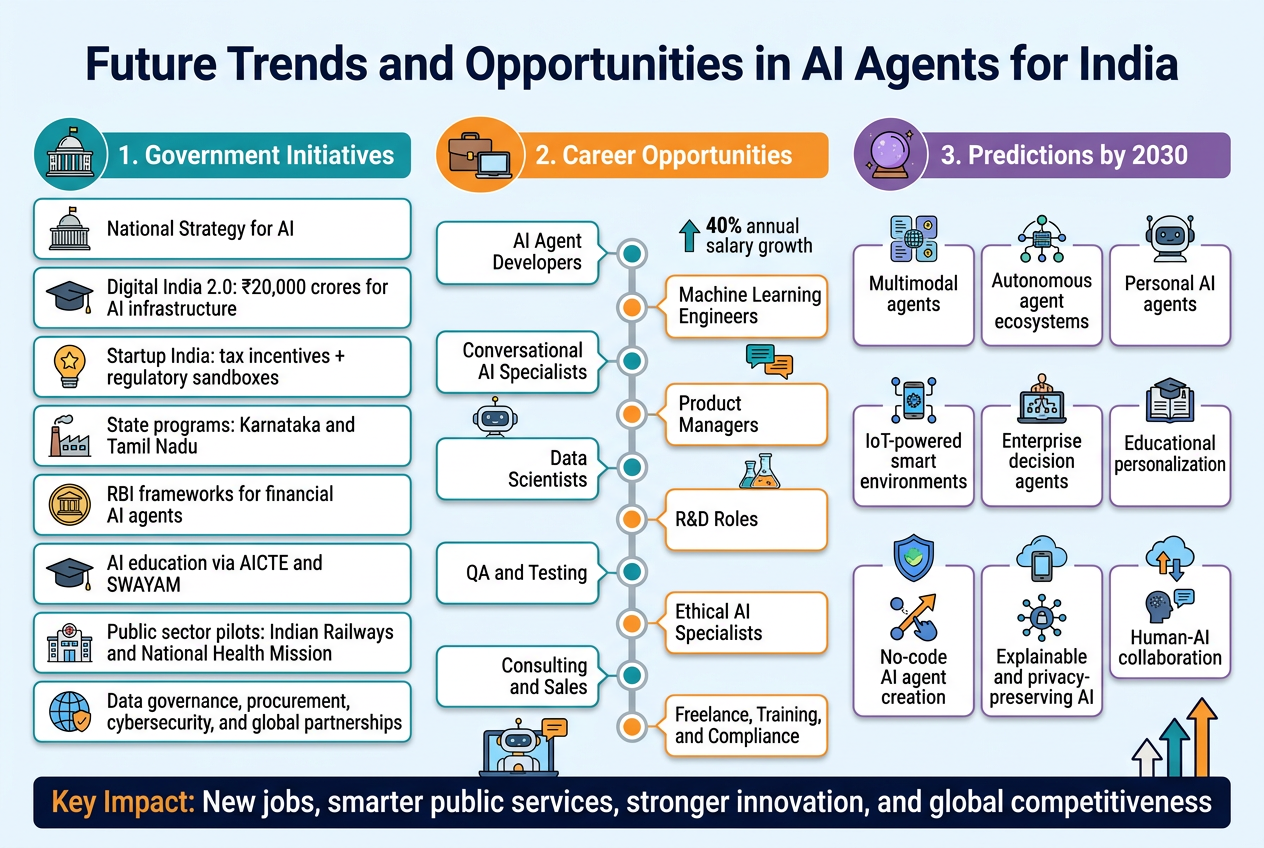
Government Initiatives Supporting AI Agent Adoption
The Indian government has recognized the transformative potential of AI agents and agentic AI technology, launching comprehensive initiatives to accelerate their adoption across sectors. The National Strategy for Artificial Intelligence positions India as a global leader in AI development, with specific focus on building autonomous systems that can operate independently and make intelligent decisions.
The Ministry of Electronics and Information Technology has established dedicated centers of excellence for AI research, with substantial funding allocated for projects involving AI agents in agriculture, healthcare, and smart cities. These centers work closely with academic institutions and private companies to develop contextually relevant solutions for Indian markets.
Digital India 2.0 framework explicitly mentions AI agents as key enablers for digital transformation. The program allocates ₹20,000 crores specifically for AI infrastructure development, including cloud computing resources, data centers, and research facilities needed to support large-scale AI agent deployment. This investment creates an ecosystem where startups and established companies can experiment with and deploy AI agents without significant upfront infrastructure costs.
The Startup India initiative has introduced special categories for AI agent development companies, offering tax incentives, fast-track licensing, and regulatory sandboxes. These sandboxes allow companies to test AI agents in controlled environments before full-scale deployment, reducing compliance risks and accelerating innovation cycles.
State governments are also joining this movement with targeted programs. Karnataka's Beyond Bengaluru initiative focuses on deploying AI agents for rural development, including agricultural advisory systems and healthcare diagnostics. Tamil Nadu has launched the Tamil Nadu AI Mission with specific targets for AI agent deployment in manufacturing and logistics sectors.
The Reserve Bank of India has created regulatory frameworks for AI agents in financial services, establishing guidelines for automated trading systems, fraud detection algorithms, and customer service bots. These regulations balance innovation with consumer protection, creating clear pathways for financial institutions to deploy AI agents safely.
Educational initiatives form another crucial component of government support. The All India Council for Technical Education has mandated AI and machine learning courses in engineering curricula, with specific modules on autonomous systems and agent-based computing. The government has also launched massive open online courses (MOOCs) on AI agent development through SWAYAM platform, making quality education accessible to millions of learners.
Public sector undertakings are becoming testing grounds for AI agent technologies. Indian Railways has deployed AI agents for predictive maintenance, route optimization, and passenger services. These real-world implementations provide valuable data and insights that benefit the broader AI agent ecosystem.
The National Health Mission integrates AI agents for disease surveillance, treatment recommendations, and resource allocation. During the COVID-19 pandemic, AI agents proved their value in contact tracing, vaccination scheduling, and hospital bed management, leading to expanded government support for health-focused AI agent development.
International collaborations form a significant part of government strategy. India has signed AI cooperation agreements with countries like the United States, France, and Japan, specifically including knowledge sharing on autonomous systems and AI agents. These partnerships bring global expertise to Indian markets while creating opportunities for Indian companies to expand internationally.
Data governance initiatives ensure that AI agents have access to high-quality, standardized datasets. The India Data Accessibility and Use Policy creates frameworks for sharing government data with AI researchers and developers, while maintaining privacy and security standards. This initiative significantly reduces the time and cost required to train AI agents for Indian contexts.
The government's procurement policies now include provisions for AI agent-based solutions, creating guaranteed markets for companies developing these technologies. Public tenders increasingly require or prefer solutions that incorporate intelligent automation and autonomous decision-making capabilities.
Cybersecurity initiatives specifically address AI agent security concerns. The National Cyber Security Coordination Centre has developed protocols for AI agent deployment that ensure these systems cannot be compromised or misused. These security frameworks are essential for building public trust in AI agent technologies.
Career Opportunities in AI Agent Development
The explosion of AI agents across industries has created unprecedented career opportunities for professionals with diverse skill sets. The demand for AI agent developers, architects, and specialists has grown exponentially, with average salaries increasing by 40% annually in this specialized field.
Software development roles have evolved significantly to accommodate AI agent requirements. Traditional programmers are upskilling to become AI agent developers, learning frameworks like LangChain, AutoGPT, and multi-agent systems. These professionals design the core logic that enables agents to perceive environments, make decisions, and take actions autonomously.
Machine learning engineers specializing in reinforcement learning find themselves in high demand, as this technology forms the backbone of many AI agent systems. Companies seek professionals who can design reward systems, optimize agent behavior through trial and error, and implement sophisticated learning algorithms that allow agents to improve their performance over time.
Conversational AI specialists have emerged as a distinct career category, focusing specifically on creating AI agents that can communicate naturally with humans. These professionals combine natural language processing expertise with user experience design, creating agents that can understand context, maintain conversations, and provide meaningful responses across various domains.
Product management roles in AI agent development require unique skill sets combining technical understanding with business acumen. AI agent product managers must understand the capabilities and limitations of autonomous systems while identifying market opportunities and user needs. They work closely with engineering teams to define agent behaviors and performance metrics.
Data scientists specializing in agent systems focus on analyzing vast amounts of interaction data to improve agent performance. They develop models that help agents understand user preferences, predict optimal actions, and adapt to changing environments. This role requires expertise in both traditional data science and emerging areas like behavioral analytics and preference learning.
Research and development positions in AI agents offer opportunities for professionals interested in pushing technological boundaries. These roles involve exploring new architectures, developing novel training methodologies, and solving complex problems related to agent coordination, safety, and scalability.
Quality assurance and testing for AI agents represents a growing field requiring specialized knowledge. Traditional software testing methods are insufficient for autonomous systems that can behave unpredictably. AI agent testers develop new methodologies for evaluating agent performance, safety, and reliability across diverse scenarios.
Ethical AI specialists focus on ensuring AI agents operate within moral and legal boundaries. They develop guidelines for agent behavior, implement bias detection systems, and create frameworks for responsible AI agent deployment. This role combines technical knowledge with expertise in ethics, law, and social sciences.
Sales and marketing professionals specializing in AI agents help organizations understand and adopt these technologies. They must translate complex technical capabilities into business benefits, demonstrating how AI agents can solve specific problems and create value. This role requires deep understanding of both technology and customer needs.
Consulting opportunities abound for experienced professionals who can help organizations implement AI agent strategies. AI agent consultants assess business processes, identify automation opportunities, and design implementation roadmaps. They often work with multiple clients across various industries, gaining broad exposure to different applications and challenges.
Training and education roles focus on building the next generation of AI agent professionals. Universities, bootcamps, and corporate training programs need instructors who can teach both theoretical foundations and practical implementation skills. These positions often combine teaching with ongoing research and development activities.
Freelance and contract opportunities are particularly abundant in AI agent development, as many companies prefer to start with pilot projects before committing to full-time hires. Independent developers can work on specific agent implementations, conduct proof-of-concept studies, or provide specialized expertise for short-term projects.
The gig economy has created opportunities for AI agent trainers - professionals who specialize in improving agent performance through targeted training data and feedback loops. These specialists understand how to curate training datasets, design reward functions, and implement human feedback systems that help agents learn desired behaviors.
Technical writing and documentation roles support the growing AI agent ecosystem by creating clear guides, tutorials, and specifications. As AI agent technologies become more accessible to non-technical users, the demand for clear, comprehensive documentation continues to grow.
Regulatory and compliance specialists help organizations navigate the complex legal landscape surrounding AI agents. They stay current with evolving regulations, develop internal policies for responsible AI agent use, and ensure compliance with industry standards and government requirements.
Predictions for AI Agent Evolution by 2030
The trajectory of AI agent development suggests transformative changes that will reshape how we interact with technology and conduct business by 2030. Current research trends and technological developments provide clear indicators of what the AI agent landscape will look like in the next six years.
Multi-modal AI agents that can process and respond to text, voice, images, and video simultaneously will become the standard rather than the exception. These agents will understand context across different media types, enabling natural interactions where users can speak, gesture, show objects, or type commands interchangeably. This evolution will make AI agents accessible to users with different communication preferences and abilities.
Autonomous agent ecosystems will emerge where multiple specialized agents collaborate without human intervention to complete complex tasks. Instead of single agents trying to handle everything, we'll see networks of agents where each has specific expertise - one agent handles data analysis, another manages communications, and a third executes actions based on collective insights. These agent teams will coordinate their activities, share information, and adapt their strategies based on collective learning.
Personal AI agents will become as common as smartphones, with each individual having a dedicated agent that learns their preferences, manages their digital life, and acts as an intelligent interface to various services. These personal agents will handle scheduling, shopping, communication, entertainment recommendations, and financial management while maintaining strict privacy boundaries and user control.
The integration of AI agents with Internet of Things (IoT) devices will create smart environments that respond intelligently to user needs without explicit commands. Homes, offices, and public spaces will contain networks of connected devices managed by AI agents that optimize energy usage, security, comfort, and productivity based on occupant behavior patterns and preferences.
Enterprise AI agents will evolve from task-specific tools to comprehensive business intelligence systems capable of making strategic decisions. These agents will analyze market trends, competitor activities, customer behavior, and internal operations to provide recommendations on product development, pricing strategies, and resource allocation. Some organizations will delegate certain business decisions entirely to AI agents within predefined parameters.
Educational AI agents will personalize learning experiences for individual students, adapting teaching methods, pace, and content based on learning styles and progress. These agents will identify knowledge gaps, suggest supplementary materials, and even create custom exercises tailored to specific learning objectives. They will also assist teachers by automating administrative tasks and providing insights into student performance.
Healthcare AI agents will provide continuous monitoring and health optimization, moving beyond diagnosis and treatment to preventive care and wellness management. These agents will analyze data from wearable devices, environmental sensors, and health records to predict health issues before they occur and recommend lifestyle modifications or medical interventions.
Creative AI agents will collaborate with human artists, writers, and designers to produce novel content that combines human creativity with AI capabilities. These agents will understand artistic styles, cultural contexts, and audience preferences to generate ideas, refine concepts, and execute creative projects under human guidance and approval.
The democratization of AI agent development will accelerate through no-code and low-code platforms that allow non-technical users to create custom agents for specific needs. Small businesses and individuals will be able to build agents that handle customer service, inventory management, content creation, and other specialized tasks without requiring programming expertise.
Emotional intelligence in AI agents will advance significantly, enabling them to recognize, understand, and respond appropriately to human emotions. These emotionally aware agents will adjust their communication style, provide empathetic responses, and recognize when human intervention is needed for sensitive situations.
Real-time learning capabilities will allow AI agents to adapt and improve continuously based on new information and changing conditions. Instead of requiring periodic retraining, these agents will update their knowledge and modify their behavior patterns on the fly, ensuring they remain effective as circumstances evolve.
Explainable AI will become a standard feature of AI agents, allowing users to understand why agents made specific decisions or recommendations. This transparency will be crucial for building trust, meeting regulatory requirements, and enabling users to provide meaningful feedback for agent improvement.
Cross-platform interoperability will enable AI agents to work seamlessly across different applications, devices, and services. Users will be able to start a task on one platform and continue it on another, with their AI agent maintaining context and continuity throughout the interaction.
Privacy-preserving AI agents will operate using federated learning and homomorphic encryption, allowing them to provide personalized services without compromising user data. These agents will learn from user interactions while keeping sensitive information encrypted and locally stored.
Specialized industry agents will emerge for sectors like agriculture, manufacturing, legal services, and logistics. These domain-specific agents will understand industry terminology, regulations, and best practices, providing expert-level assistance for complex professional tasks.
The convergence of AI agents with augmented reality and virtual reality will create immersive experiences where users can interact with virtual agents in three-dimensional environments. These interactions will feel natural and intuitive, bridging the gap between digital and physical worlds.
Global AI agent networks will facilitate international collaboration and knowledge sharing, allowing agents developed in different countries to communicate and share insights while respecting local regulations and cultural differences. This global connectivity will accelerate innovation and problem-solving on a worldwide scale.
Energy-efficient AI agents will run on edge devices and optimize their computational requirements based on task complexity and available resources. These lightweight agents will provide intelligent functionality without requiring constant cloud connectivity or consuming excessive battery power.
Proactive AI agents will anticipate user needs and take preventive actions before problems occur. Instead of waiting for commands or issues to arise, these agents will monitor patterns and initiate helpful actions based on predicted future needs.
The economic impact of AI agents will extend beyond automation to create entirely new business models and market opportunities. Companies will emerge that specialize in agent development, training, and management services, while existing businesses will restructure their operations around AI agent capabilities.
Human-AI collaboration will evolve into seamless partnerships where the boundaries between human and artificial intelligence become less distinct. AI agents will handle routine and analytical tasks while humans focus on creative, strategic, and interpersonal aspects of work, leading to enhanced productivity and job satisfaction.
These predictions reflect current technological trajectories and research developments, but the actual evolution of AI agents may include unexpected breakthroughs that accelerate or redirect these trends. The key factors influencing this evolution include advances in computing power, algorithm development, data availability, and regulatory frameworks that balance innovation with safety and ethical considerations.
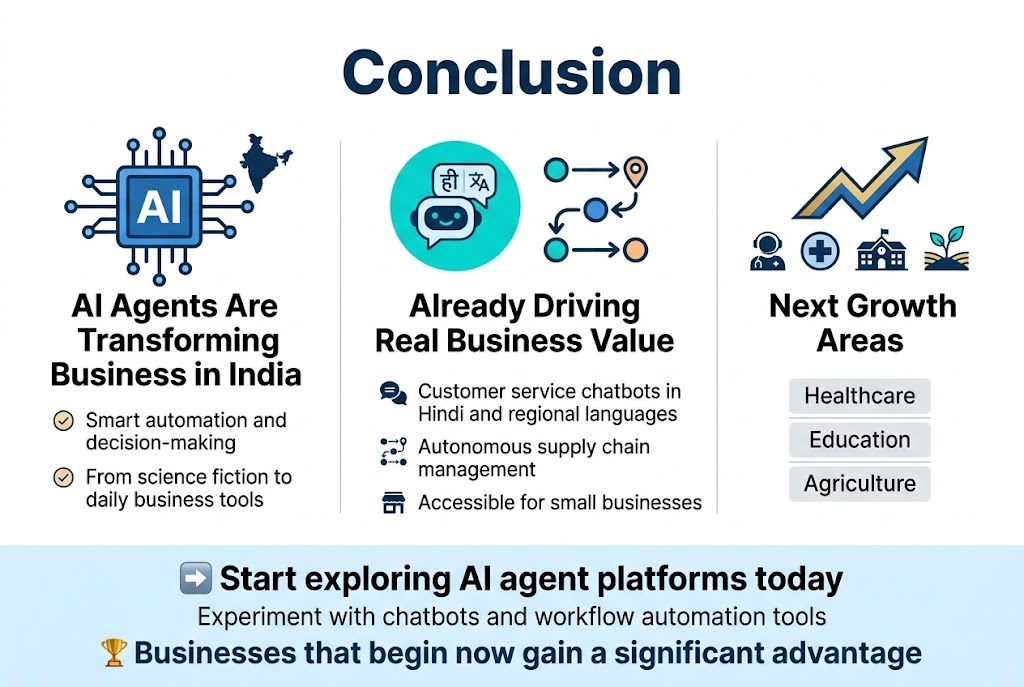
AI agents are reshaping how businesses operate in India, bringing smart automation and decision-making capabilities that were once just science fiction. From customer service chatbots that understand Hindi and regional languages to autonomous systems managing supply chains, these intelligent assistants are becoming essential tools for companies wanting to stay competitive. The technology has matured enough that even small businesses can now afford to implement basic AI agents, making this revolution accessible across different economic segments.
The next few years will see explosive growth in agentic AI adoption across India, especially in sectors like healthcare, education, and agriculture where personalized solutions can make a real difference. Start exploring AI agent platforms today, even if it's just experimenting with simple chatbots or workflow automation tools. The businesses that begin their AI journey now will have a significant advantage over those who wait and watch from the sidelines.

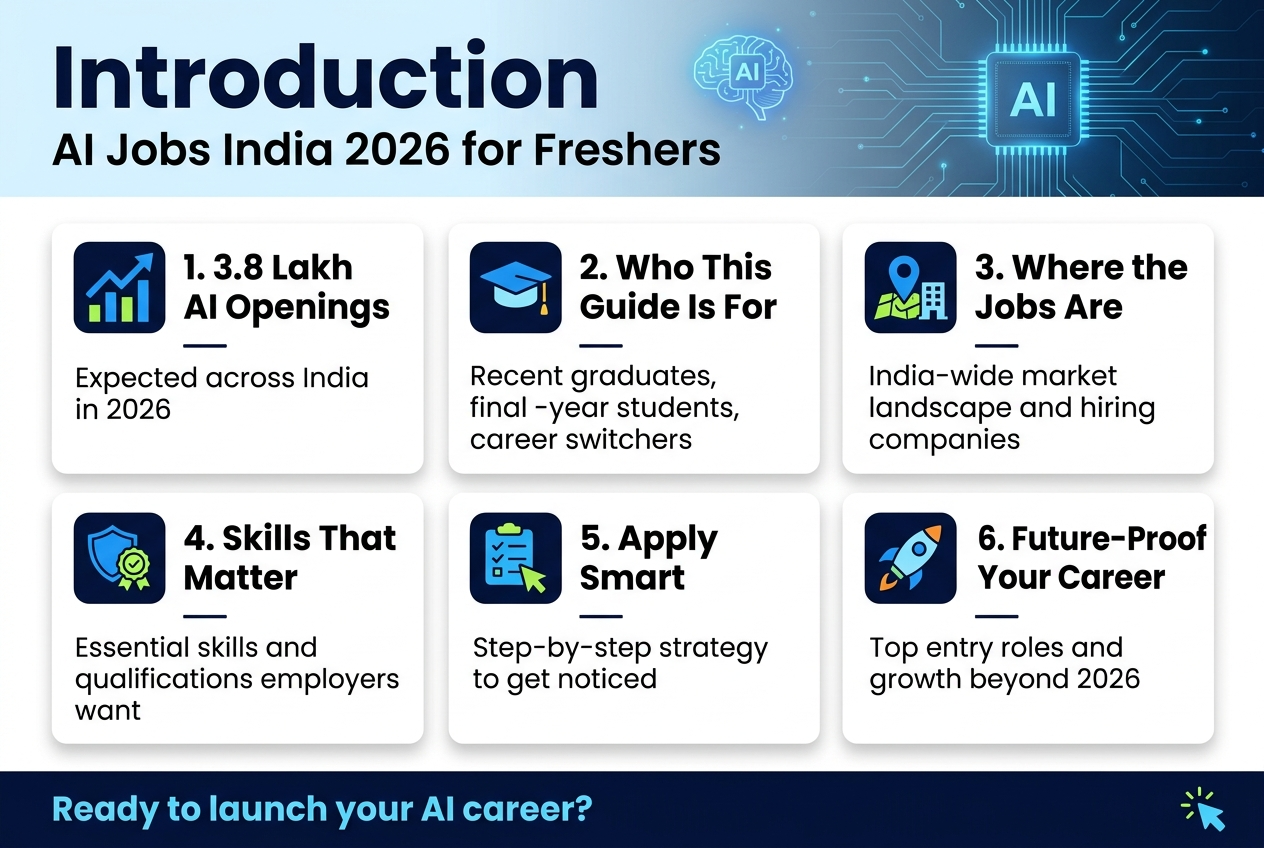



Comments (0)